


The best Protegrity alternatives for 2026: 1. Enigma Vault, 2. Fortanix, 3. OpenText Voltage SecureData, 4. Thales CipherTrust Tokenization, 5. comforte TAMUNIO, 6. Skyflow, 7. Baffle, 8. Capital One Databolt.
Protegrity is an enterprise data protection platform that tokenizes, masks and encrypts sensitive data across databases, data warehouses and AI workflows, and its newer AI editions add discovery, semantic guardrails and agent controls. G2 lists it under categories including Data Masking, Data De-Identification, Encryption and Sensitive Data Discovery. Buyers usually compare it with other options on three things: How tokens are made (vaulted or vaultless), which platforms it protects natively, and whether they can see a price before a sales call.
The best overall alternative to Protegrity is Enigma Vault, which publishes every plan, starts free, and covers both application data (Data Vault) and LLM traffic (Enigma Vault NoPII) on one PCI DSS Level 1 and SOC 2 Type II vault. Other well-known alternatives to Protegrity are:
- Fortanix: Best suited to vaultless, format-preserving tokenization with HSM-backed keys (G2 rating 4.5 from 2 reviews)
- OpenText Voltage SecureData: Offers format-preserving encryption across mainframe, Hadoop, Teradata and Snowflake
- Thales CipherTrust Tokenization: Known for vaulted and vaultless tokenization in one platform (G2 rating 4.0 from 6 reviews)
- Baffle: Best for protecting existing databases without code changes (G2 rating 4.4 from 11 reviews)
Every rating in this guide links to the product’s G2 or Capterra page, so you can read the verified reviews behind each like, dislike and score for yourself.
Disclosure: Enigma Vault publishes this comparison and appears in it, first. Every competitor fact comes from that vendor’s own public pages.
Top 8 Alternatives to Protegrity at a Glance
| Provider | Best for | How it protects data | Deployment | Starting price | G2 rating | Our score (/5) |
|---|---|---|---|---|---|---|
| Enigma Vault | Searchable Tokenization and LLM Data Privacy | Vault-based tokens with exact-match lookup; tokenizes LLM traffic | Cloud API and proxy | Free, then $49 a month per product | 4.4/5 (6) | 3.9 |
| Fortanix | Vaultless Tokenization With HSM-Backed Keys | Vaultless format-preserving encryption | On-premises or SaaS | Contact sales | 4.5/5 (2) | 3.5 |
| OpenText Voltage SecureData | Format-Preserving Encryption on Mainframe and Big Data | Format-preserving encryption and tokenization, stateless keys | On-premises and cloud | Contact sales | Not listed | 3.5 |
| Thales CipherTrust Tokenization | Vaulted and Vaultless Tokenization | Vaulted and vaultless tokenization, masking | CipherTrust platform | Contact sales | 4.0/5 (6) | 3.2 |
| comforte TAMUNIO | Tokenization on Mainframe and HPE NonStop | Format-preserving protection | Cloud and on-premises | Contact sales (request a demo) | No reviews yet | 3.2 |
| Skyflow | PII Vaults With Broad Compliance Certifications | Vault-based tokenization and polymorphic encryption | Hosted vault | Contact sales | No GenAI reviews yet | 3.1 |
| Baffle | No-Code Database Encryption and Masking | Masking, tokenization and encryption | Cloud and on-premises | Contact sales (schedule a demo) | 4.4/5 (11) | 3.0 |
| Capital One Databolt | Tokenizing Data in Snowflake and Databricks | Tokenization with dynamic masking | Snowflake and Databricks | Contact sales (book a call) | Not listed | 2.8 |
Choose the right plan for the data you protect. Card, Data and File Vault each start with a free Lite sandbox, and Enigma Vault NoPII protects your first million tokens a month at no cost.
TL;DR
- Enigma Vault (3.9/5): Published plans that start free, searchable field encryption through Data Vault, and LLM protection through Enigma Vault NoPII.
- Fortanix (3.5/5): Vaultless, format-preserving tokenization with FIPS 140-2 Level 3 HSMs, on-premises or SaaS, with a free trial.
- OpenText Voltage SecureData (3.5/5): FF1 format-preserving encryption and stateless keys across mainframe, Hadoop, Teradata and Snowflake.
- Thales CipherTrust Tokenization (3.2/5): Vaulted and vaultless tokenization with masking, inside the CipherTrust platform.
- comforte TAMUNIO (3.2/5): Discovery and format-preserving protection across cloud, on-premises and HPE NonStop.
- Skyflow (3.1/5): A vault-based privacy platform with AI coverage and the longest certification list here.
- Baffle (3.0/5): Masking, tokenization and encryption for databases and GenAI pipelines with no code changes.
- Capital One Databolt (2.8/5): Tokenization with dynamic masking that runs inside Snowflake and Databricks.
Why Teams Look for Protegrity Alternatives
Protegrity has real strengths: Vaultless tokenization that scales, native protectors for Databricks, Snowflake, Redshift and Cloudera, and AI editions with guardrails and agent controls. These are the reasons buyers most often look elsewhere.
- Pricing needs a sales call: Protegrity publishes no prices; its pricing page returns a not-found page, and the Team and Enterprise editions start with a demo.
- Deployment is AWS-first for now: The Enterprise edition page says current deployment is AWS-specific, on Kubernetes (EKS, ECS or Docker Compose).
- It is built for large estates: Policy management, protectors for each platform family and a Kubernetes deployment are a lot to run when the job is protecting a few fields or one AI feature.
- Reviewers mention price: One G2 reviewer finds the price range a little high, and small-business reviewers rate it lower than enterprise ones.
How We Scored These Protegrity Alternatives
We scored every provider on the same six criteria, weighted for a team replacing or avoiding an enterprise data protection platform. Weights sum to 100%, and the score in the table is the weighted result.
- Pricing transparency and time to start (25%): Whether you can see a price and protect data without a sales cycle.
- Tokenization approach (20%): Vaulted or vaultless, format preservation, and whether data stays usable.
- AI data protection (15%): Coverage of prompts, model responses, RAG and agents.
- Deployment options (15%): Cloud, on-premises, hybrid and data residency.
- Platform coverage (15%): Native support for databases, warehouses and big data platforms.
- Compliance evidence (10%): What the vendor publishes on its own trust pages.
This is an editorial comparison published by one of the vendors in it. Weight platform coverage higher and OpenText Voltage SecureData leads; weight compliance evidence higher and Skyflow climbs.
The 8 Best Protegrity Competitors and Data Tokenization Alternatives
Each entry covers what the product is, what it does, what it costs, where it falls short, and what verified G2 reviewers say.
1. Enigma Vault: Best for Searchable Tokenization and LLM Data Privacy
- Starting price
- Free, then $49 a month per product
- Free tier or trial
- Free Lite plan on Data Vault and NoPII
- Deployment
- Cloud; NoPII self-hosted on Enterprise
- What it replaces from Protegrity
- Field-level tokenization for application data, plus PII protection for LLM prompts, responses and embeddings
- G2 categories in common with Protegrity
- Encryption, Data De-Identification (Enigma Vault NoPII is also listed in AI Security Solutions)
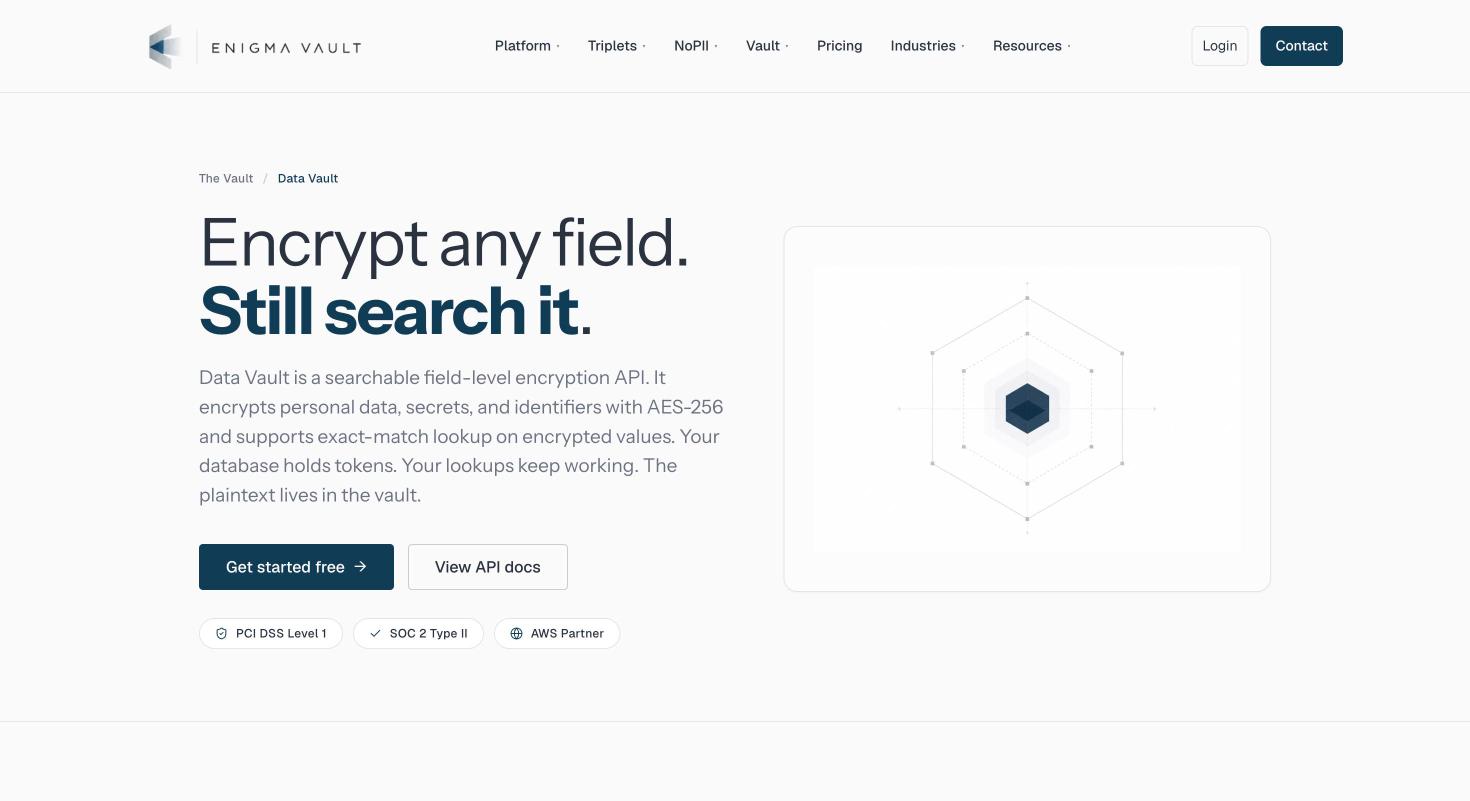
Enigma Vault is a data security platform built on a PCI DSS Level 1 and SOC 2 Type II vault. Its Data Vault is a searchable field-level encryption API: It encrypts personal data, secrets and identifiers with AES-256, your database holds tokens, and exact-match lookups on encrypted values keep working.
For AI workloads, Enigma Vault NoPII is an LLM privacy proxy that tokenizes sensitive values before they reach the model provider and restores them in the response. It covers prompts, responses, tool-call arguments and results, and the embeddings endpoint.
For a Protegrity buyer, the difference is how you start. Every Enigma Vault plan is published, both products start free, and you protect your first field or prompt through an API or a base URL change rather than a platform rollout. The trade is reach: Protegrity ships native protectors for Snowflake, Databricks, Redshift and Cloudera, which Enigma Vault does not.
Key features
- Searchable field-level encryption: AES-256 encryption with exact-match lookup on encrypted values
- Batch tokenization: Up to 500 values per call, or 5,000 on Growth and Business
- LLM privacy proxy: Enigma Vault NoPII tokenizes PII before it reaches the model provider and restores it in the response
- AI coverage: Prompts, responses, tool-call arguments and results, and embeddings for RAG pipelines
- Detection: 11 entity types on by default, 25+ more to opt into, and 14 families of secrets and API keys
- Fail-safe by default: If NoPII cannot tokenize a request, it blocks it rather than forwarding it
- Deployment options: Cloud API, with a self-hosted NoPII edition on Enterprise
- Compliance documents: PCI AOC, SOC 2 Type II report and DPA on paid Data Vault plans; BAA for healthcare on Enterprise
Pricing
| Plan | Data Vault | Enigma Vault NoPII |
|---|---|---|
| Lite (free) | 1,500 requests a month, 100 stored tokens | 1M protected tokens a month |
| Starter ($49/mo) | 30,000 requests, then $0.013 each | 50M protected tokens, then $1.00 per million |
| Growth ($249/mo) | 400,000 requests, then $0.0065 each | 500M protected tokens, then $0.80 per million |
| Business ($499/mo) | 2M requests, then $0.0045 each | 2B protected tokens, then $0.60 per million |
| Enterprise | Contact sales | Custom, including the self-hosted edition |
Each product is priced separately, and yearly billing saves on Starter, Growth and Business. Paid Data Vault plans include the PCI AOC, SOC 2 Type II report and DPA, and an EU data residency add-on is available from Growth at $99 a month.
Pros
- Every plan published, and both products start free
- Covers application data and LLM traffic with the same vault behind them
- Exact-match lookup keeps search working on encrypted fields
- EU data residency available as an add-on
Cons
- No native protectors for Snowflake, Databricks, Redshift or Cloudera
- Data Vault runs as a hosted API; only NoPII offers a self-hosted edition, on Enterprise
- One reviewer finds pricing a bit high for the product
- A smaller public review base than the enterprise suites
What users say
- Likes: Simple API and clear PCI scope: A CEO reviewer calls the API simple and easy to understand, with no surprises on PCI DSS de-scoping and pricing below other vendors (source), and another values handling card data, personal information and multi-GB files in one place (source).
- Dislikes: Pricing and documentation: One reviewer finds pricing a bit high for the product (source), and another sees room for more documentation (source).
Rated 4.4/5 on G2 from 6 reviews and 4.8/5 on Capterra from 4 reviews. Enigma Vault NoPII is listed separately on G2 with 1 review.
Watch for: If your protected data lives mainly in warehouses and lakehouses, check whether an API in front of your applications covers your data flows before you compare it with in-platform protectors.
For the architecture question behind this choice, read our guide to vault vs vaultless tokenization, or compare Enigma Vault plans.
2. Fortanix: Best for Vaultless Tokenization With HSM-Backed Keys
- Starting price
- Contact sales
- Free tier or trial
- Free trial
- Deployment
- On-premises or SaaS
- What it replaces from Protegrity
- Vaultless format-preserving tokenization with HSM-backed key management
- G2 categories in common with Protegrity
- Cloud Data Security, Encryption
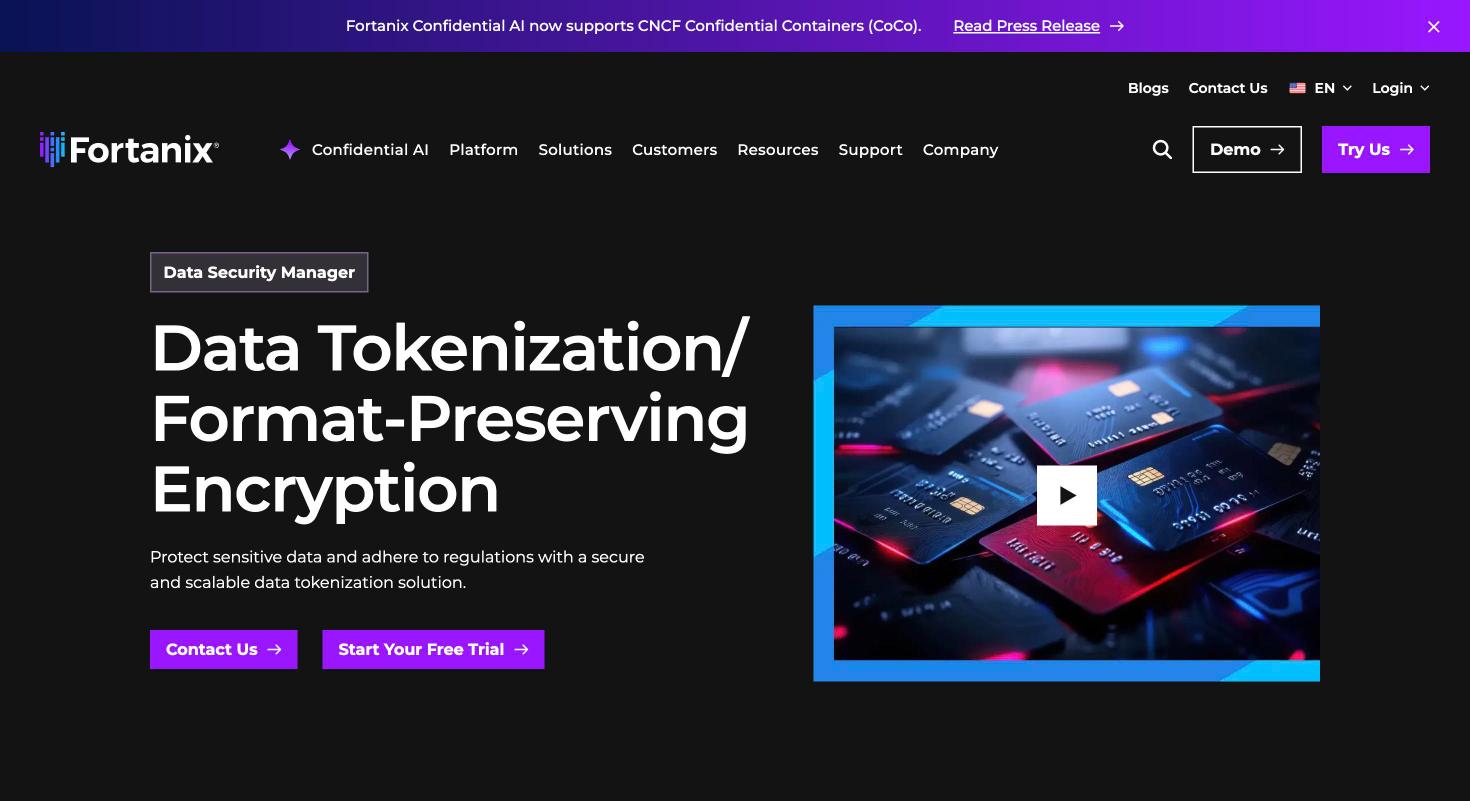
Fortanix Data Security Manager offers vaultless tokenization based on format-preserving encryption, alongside key management. Tokens are generated with NIST-approved cryptography, and keys are protected in FIPS 140-2 Level 3 HSMs that run on-premises or as SaaS.
For a Protegrity buyer, Fortanix is the closest match on architecture: Vaultless, format-preserving and key-management-led, with a free trial to start.
Key features
- Vaultless tokenization: No central token database, using NIST-approved cryptography
- Format-preserving encryption: Tokens keep the format of the original data
- HSM-backed keys: Integrates natively with FIPS 140-2 Level 3 compliant HSMs
- Access control: Granular role-based access with quorum approvals
- Deployment: On-premises or SaaS
- Key management: Part of a wider multicloud key management platform
Pricing
No prices are published. Fortanix offers a free trial, a demo and a contact form.
Pros
- Vaultless and format-preserving, like Protegrity
- HSM-backed key security
- A free trial without a sales call
Cons
- A reviewer wants more visibility into how keys are used across applications
- Managing many encryption devices can be strenuous in large networks, per a reviewer
- Key management comes first; discovery and AI guardrails are not the focus
What users say
- Likes: Data-centric flexibility: Reviewers value its data-centric approach (source) and keys separated from hardware for more flexibility than traditional key management (source).
- Dislikes: Key visibility and device management: One reviewer wants more granular visibility into how keys are used (source), and another finds managing and monitoring many encryption devices strenuous (source).
Rated 4.5/5 on G2 from 2 reviews and 5.0/5 on Capterra from 1 review.
Watch for: Ask how tokenization is licensed alongside the key management platform, since pricing is quoted.
For how vaultless tokens compare with vault-based ones, read vault vs vaultless tokenization.
3. OpenText Voltage SecureData: Best for Format-Preserving Encryption on Mainframe and Big Data
- Starting price
- Contact sales
- Free tier or trial
- Not offered
- Deployment
- On-premises, cloud and big data platforms
- What it replaces from Protegrity
- Format-preserving encryption and tokenization across mainframe, Hadoop, Teradata and Snowflake
- G2 categories in common with Protegrity
- Not listed on G2
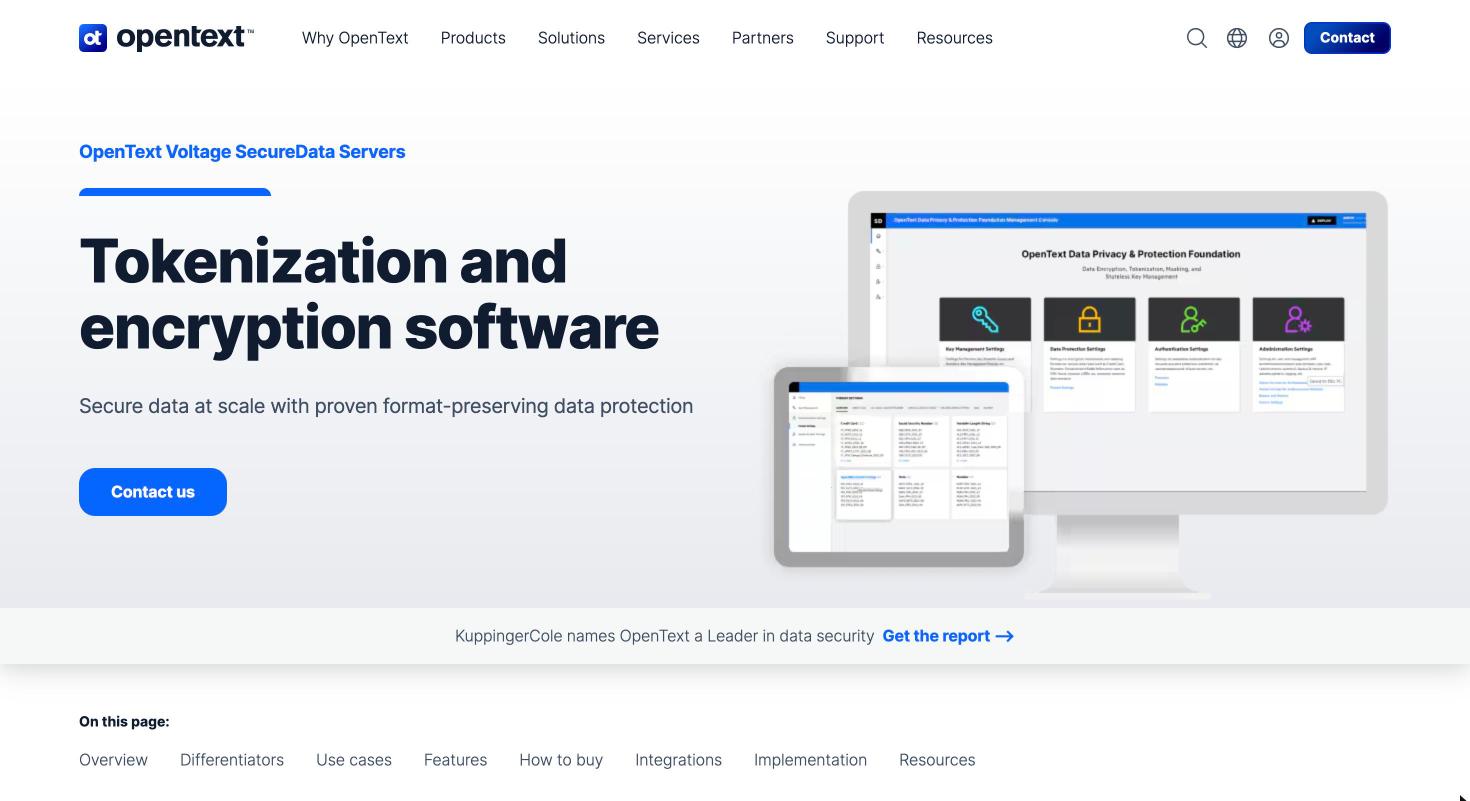
OpenText Voltage SecureData Servers protects data with format-preserving encryption (NIST-approved AES FF1) and tokenization, and derives keys on demand through stateless key management, so there is no key store to replicate or back up.
Its reach across older and big data platforms is the draw for a Protegrity buyer: It lists Windows, Linux, IBM z/OS, Hadoop, Vertica, Teradata and Snowflake.
Key features
- Format-preserving encryption: NIST-approved AES FF1 with field-level, consistent protection
- Tokenization: High-performance tokenization alongside FPE
- Stateless key management: Keys derived on demand, with no storage, replication or backup
- Broad platform support: Windows, Linux, IBM z/OS, Hadoop, Vertica, Teradata and Snowflake
- Policy and access: Integrates with Active Directory, OpenID and certified HSMs
- Integration: REST APIs and native Java, C# and .NET SDKs
Pricing
No prices are published. OpenText routes buyers to its sales team.
Pros
- The broadest legacy and big data platform list here
- Stateless keys remove a key database to manage
- Named a Leader in data security by KuppingerCole, per OpenText
Cons
- No independent reviews on G2 or Capterra for SecureData
- Sales-led buying with no free option
- Product naming has moved under OpenText’s Data Privacy & Protection Foundation, so documentation can be harder to find
What users say
Reviews: No G2 or Capterra listing for SecureData yet.
Watch for: Confirm which connectors are included in your quote, since platform coverage is the main reason to choose it.
For how format-preserving tokens fit into existing databases, see our guide to data tokenization.
4. Thales CipherTrust Tokenization: Best for Vaulted and Vaultless Tokenization
- Starting price
- Contact sales
- Free tier or trial
- Not offered
- Deployment
- Part of the CipherTrust Data Security Platform
- What it replaces from Protegrity
- Vaulted or vaultless tokenization with static and dynamic masking
- G2 categories in common with Protegrity
- Data Masking, Data De-Identification
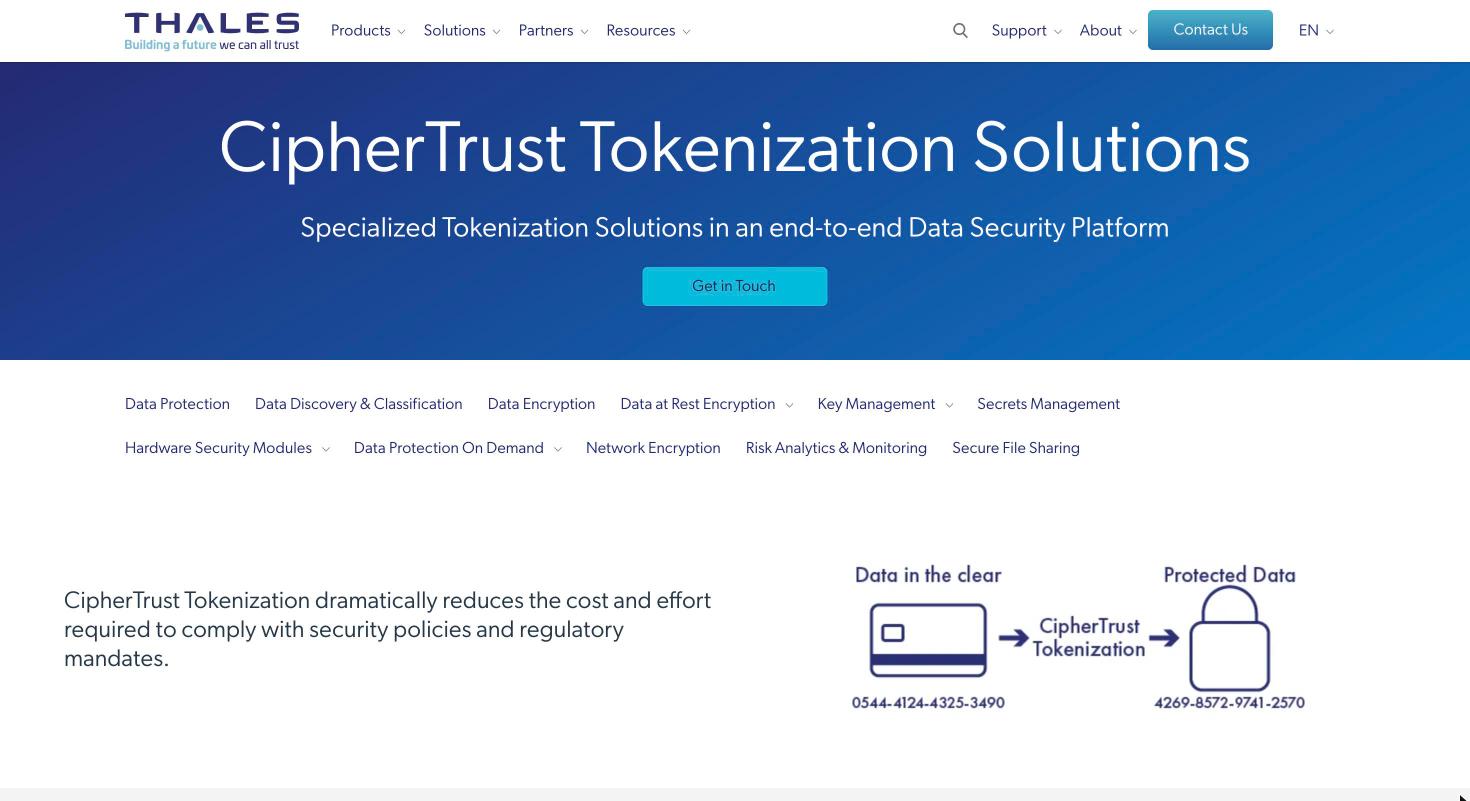
Thales CipherTrust Tokenization offers vaulted and vaultless tokenization that can be used on their own or with data masking and redaction. It sits inside the CipherTrust Data Security Platform, which Thales is combining with Imperva Data Security Fabric.
For a Protegrity buyer already using Thales for keys or HSMs, it keeps tokenization in the same platform.
Key features
- Vaulted and vaultless tokenization: Use either model, or both
- Static and dynamic masking: Obscure data for testing, training and live use
- Redaction: Remove values entirely where they are not needed
- PCI DSS support: Protect and share payment card data
- Platform: Part of the CipherTrust Data Security Platform with key management, encryption and HSMs
- Roadmap: CipherTrust is being combined with Imperva Data Security Fabric
Pricing
No prices are published. The page routes to Get in Touch and Contact Sales.
Pros
- Choice of vaulted or vaultless tokenization
- Fits teams already on Thales keys and HSMs
- Masking and redaction in the same product
Cons
- A reviewer finds it expensive for small businesses
- Reviewers mention implementation complexity, token management and cost
- Lower G2 rating than most alternatives here
What users say
- Likes: Easy protection on-premises or in the cloud: A reviewer says it protects important data and is easy to use (source), and another values consoles for both on-premises and cloud (source).
- Dislikes: Cost and complexity: One reviewer finds it expensive for small businesses (source), and another lists implementation complexity, token management and cost (source).
Rated 4.0/5 on G2 from 6 reviews. No Capterra listing found.
Watch for: Ask how the Imperva combination affects your licensing and roadmap before a multi-year commitment.
For the PCI view across tokenization vendors, see the best PCI DSS compliant tokenization software.
5. comforte TAMUNIO: Best for Tokenization on Mainframe and HPE NonStop
- Starting price
- Contact sales (request a demo)
- Free tier or trial
- Not offered
- Deployment
- Cloud and on-premises
- What it replaces from Protegrity
- Discovery and format-preserving protection across cloud, on-premises and mainframe
- G2 categories in common with Protegrity
- None; G2 lists comforte’s SecurDPS under Data Security Services
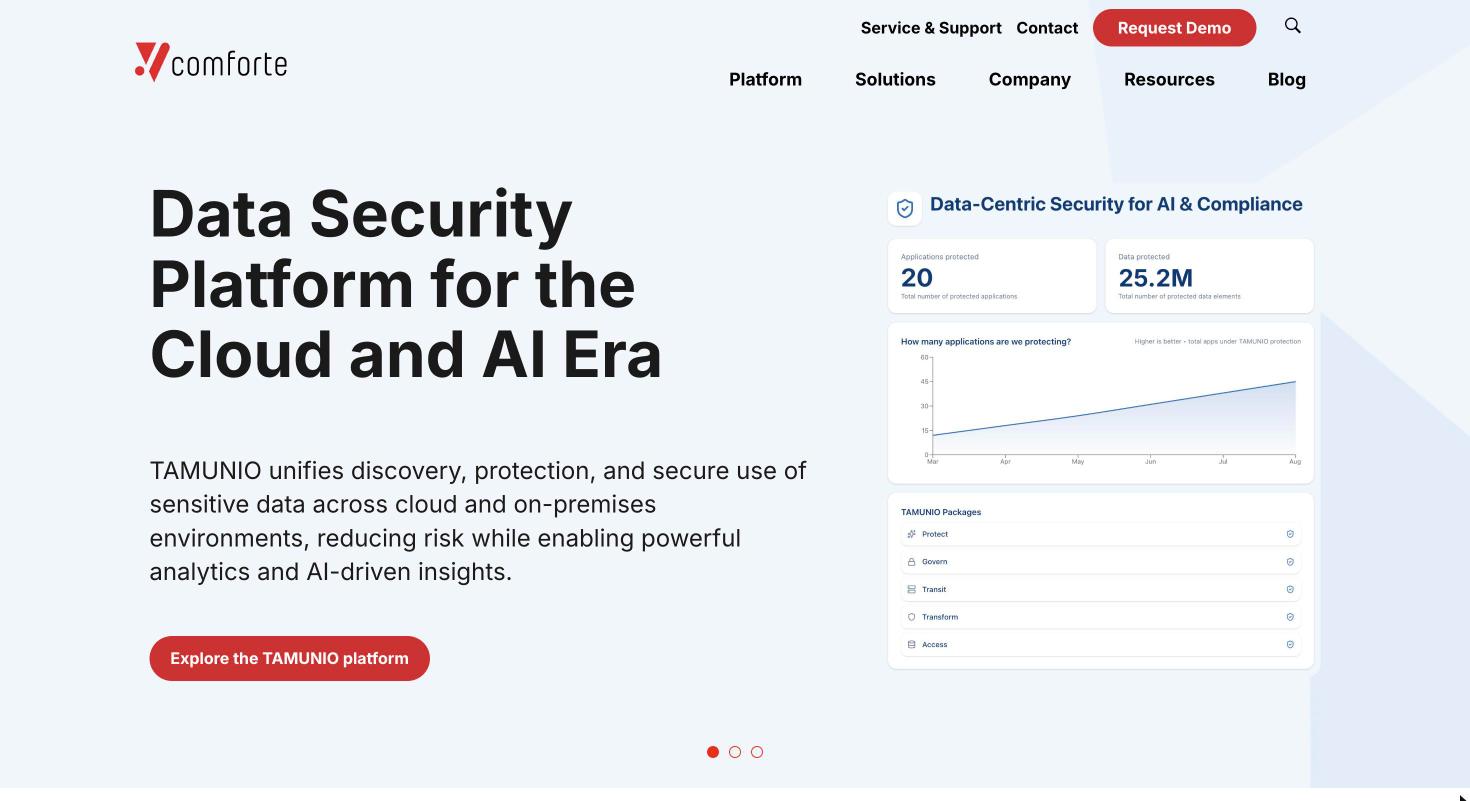
comforte’s TAMUNIO platform unifies discovery, protection and secure use of sensitive data across cloud and on-premises environments. It protects fields with format-preserving methods that keep the original structure of the data, and adds Data Sovereignty Zones that use Confidential Computing.
It suits a Protegrity buyer in banking and payments, especially one running HPE NonStop, where comforte has deep roots.
Key features
- Unified platform: Discovery, protection and secure use of sensitive data in one place
- Format-preserving protection: Keeps data structure and relationships for analytics and AI
- Data Sovereignty Zones: Protect data in use with Confidential Computing, so cloud providers cannot see it
- Cloud and on-premises: Covers both environments
- HPE NonStop: TAMUNIO Assure adds quantum-ready SSH and TLS security for NonStop systems
- PCI results: Comforte cites reduced PCI scope and audit cost for customers
Pricing
No prices are published. comforte routes buyers to Request Demo.
Pros
- Strong fit for banks and payment processors on mainframe and NonStop
- Confidential Computing for data in use
- Format-preserving protection for analytics
Cons
- No independent reviews on G2 or Capterra
- SecurDPS has been folded into TAMUNIO, so older documentation may not match the current product
- Sales-led, with no free option
What users say
Reviews: No G2 or Capterra reviews yet.
Watch for: If you run SecurDPS today, ask how the upgrade path to TAMUNIO affects licensing.
For tokenization in financial services, see our roundup of the best tokenization software for fintech.
6. Skyflow: Best for PII Vaults With Broad Compliance Certifications
- Starting price
- Contact sales
- Free tier or trial
- Demo only
- Deployment
- Hosted vault with data residency support
- What it replaces from Protegrity
- Tokenization, access control and re-identification for PII, PHI and PCI data, including AI agents
- G2 categories in common with Protegrity
- Encryption (Payments Data Privacy Vault), Data De-Identification (Skyflow for GenAI)
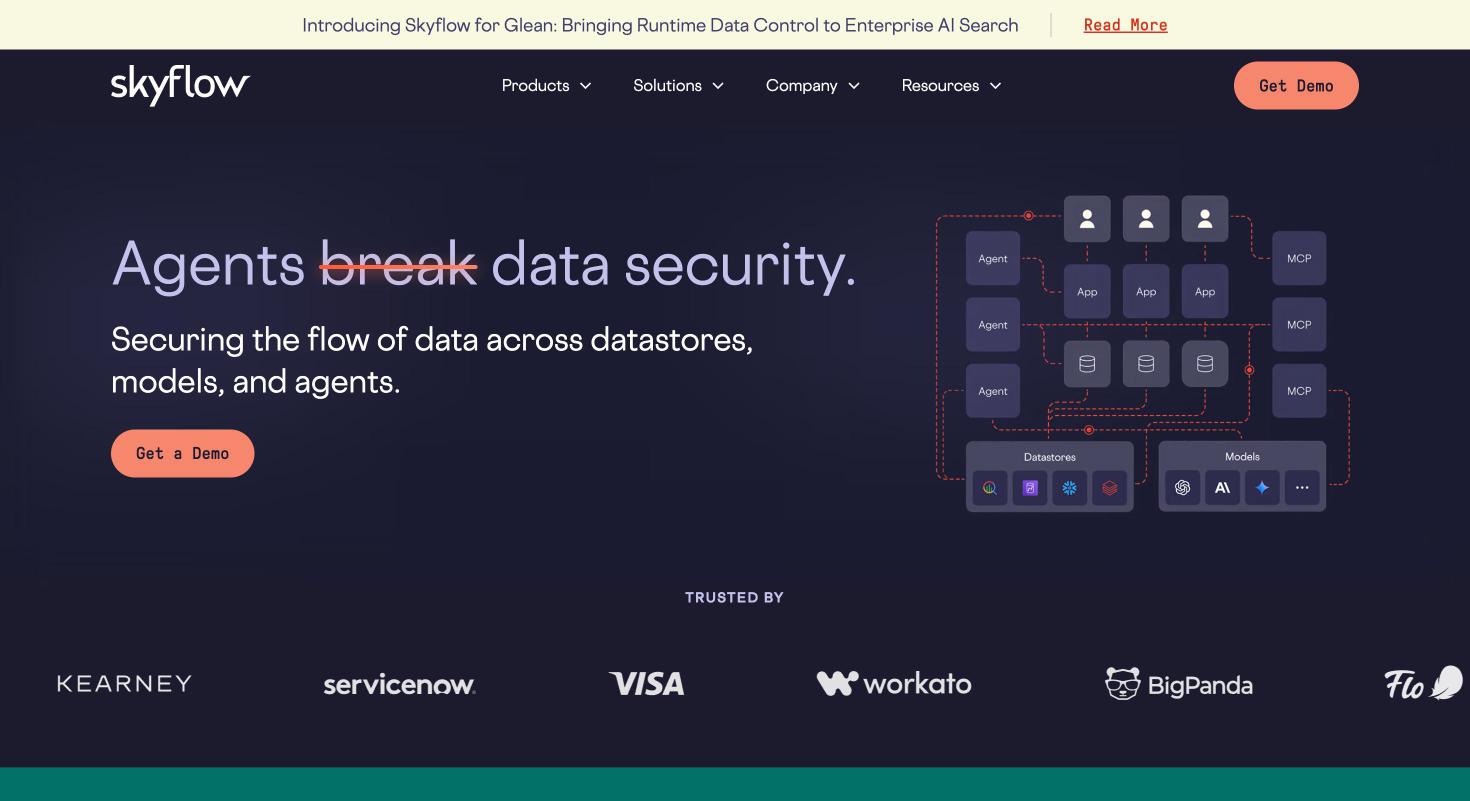
Skyflow is a data privacy vault that detects, isolates and protects sensitive data, including data flowing into and out of AI agents across training, RAG and inference. It uses tokenization and polymorphic encryption, and authorized users can re-identify data when needed.
Where Protegrity is vaultless, Skyflow is vault-based, so it suits a buyer who wants the sensitive values held by a provider rather than derived by algorithm.
Key features
- Tokenization and polymorphic encryption: Protects values while authorized users can re-identify them
- AI lifecycle coverage: Detection and redaction across data collection, training, fine-tuning, RAG and inference
- Access control: Fine-grained rules over who sees which data, and for how long
- Data residency: Support for country-specific storage requirements
- Agentic AI security: An AI and MCP security use case
- Integrations: Snowflake, Databricks, Glean and ServiceNow are listed
Pricing
No prices are published. The pricing page routes to a demo request or Contact Sales.
Pros
- The longest certification list here: SOC 2 Type II, ISO 27001:2022 and PCI DSS Level 1
- Covers AI and non-AI data in one vault
- Explicit data residency support
Cons
- A reviewer reports occasional slowness
- A hosted vault, with no on-premises option named
- The GenAI product has no independent reviews yet
What users say
- Likes: HIPAA-aligned storage: A reviewer values that the healthcare vault securely stores key and value pairs in line with HIPAA (source).
- Dislikes: Occasional slowness: The same reviewer has sometimes faced slowness on the system (source).
Skyflow for GenAI has no G2 reviews yet; Skyflow’s Healthcare and Payments vault listings have one 5.0/5 review each. No Capterra listing found.
Watch for: Vault-based and vaultless tokens are not interchangeable, so plan re-tokenization if you move from Protegrity.
For more on this model, read our guide to the data privacy vault or our Skyflow alternatives.
- Starting price
- Contact sales (schedule a demo)
- Free tier or trial
- Not offered
- Deployment
- Cloud and on-premises
- What it replaces from Protegrity
- Masking, tokenization and encryption for databases and data pipelines without code changes
- G2 categories in common with Protegrity
- Encryption, Data Masking, Data De-Identification
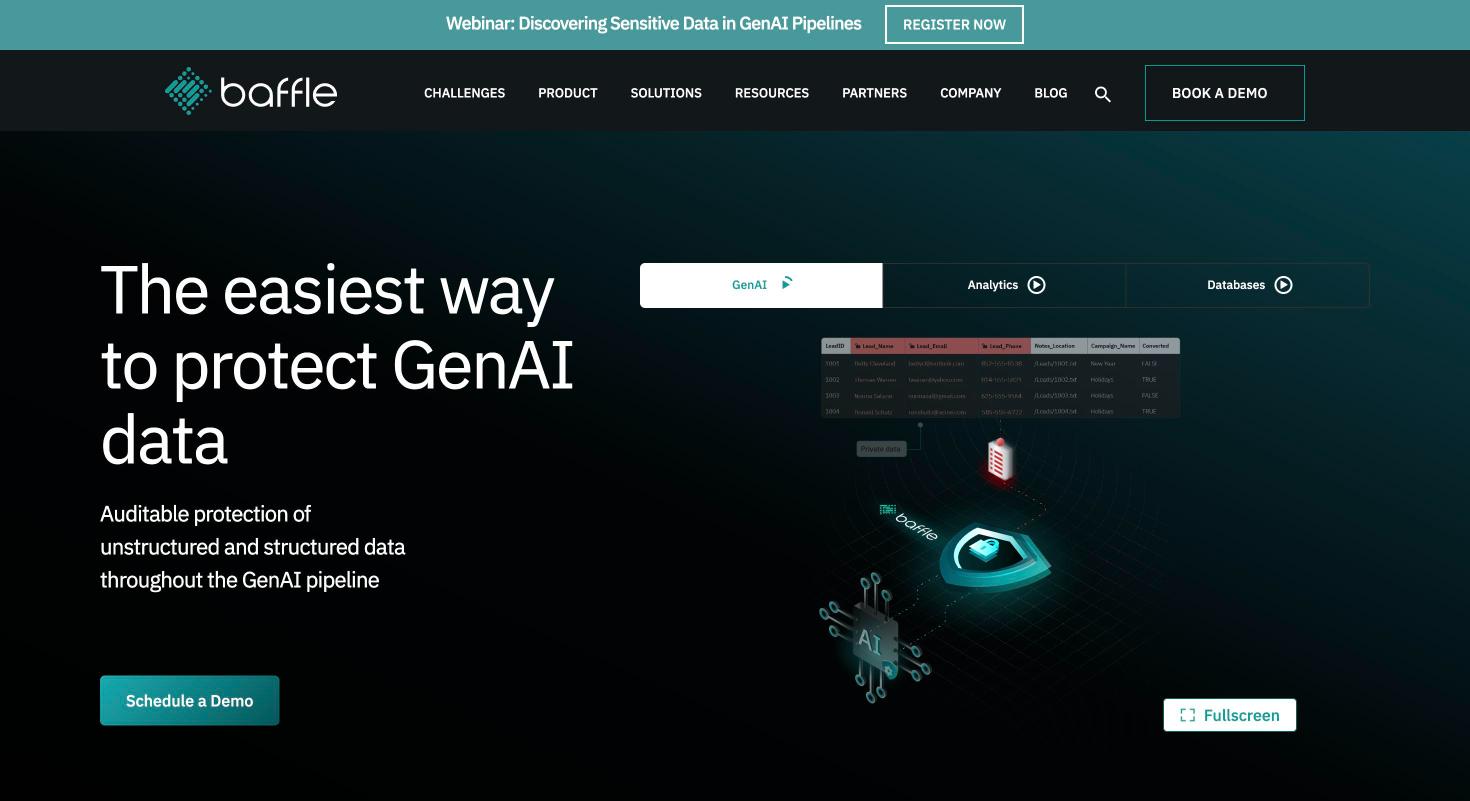
Baffle protects data in databases, analytics platforms and GenAI pipelines with masking, tokenization and encryption, using role-based access control down to individual values. It works without code changes and runs in the cloud or on-premises.
For a Protegrity buyer, Baffle’s appeal is fast rollout to existing databases without touching application code.
Key features
- Masking, tokenization and encryption: With role-based access for individual data values
- No code changes: Protection applied without rewriting applications
- Queryable encryption: Including for PostgreSQL
- Bring your own key: Customers can control their own keys
- GenAI pipelines: Protection for structured and unstructured data in AI workflows
- Deployment: Cloud and on-premises
Pricing
No prices are published. Baffle routes buyers to Schedule a Demo.
Pros
- No code changes to protect existing databases
- Customizable, with a full audit trail, per a reviewer
- Covers GenAI pipelines as well as databases
Cons
- One reviewer sees its focus as limited to financial services and healthcare
- A small-business reviewer doubts that field and record encryption fully secures their data
- Small-business reviewers rate it lower than mid-market ones
What users say
- Likes: It just works: A reviewer says it is customizable, worked from installation, and gives a full audit trail (source), and another values transparent protection at field or file level (source).
- Dislikes: Narrow focus: One reviewer sees a limited focus on financial services and healthcare (source), and another is not convinced field and record encryption fully protects their data (source).
Rated 4.4/5 on G2 from 11 reviews. Baffle is listed on Capterra with no reviews yet.
Watch for: Check database and data platform support for your exact stack, since no-code protection depends on the proxy supporting it.
For the database angle, see our roundup of the best data tokenization software.
8. Capital One Databolt: Best for Tokenizing Data in Snowflake and Databricks
- Starting price
- Contact sales (book a call)
- Free tier or trial
- Not offered
- Deployment
- Inside Snowflake and Databricks
- What it replaces from Protegrity
- Tokenization with dynamic masking inside Snowflake and Databricks
- G2 categories in common with Protegrity
- Not listed on G2
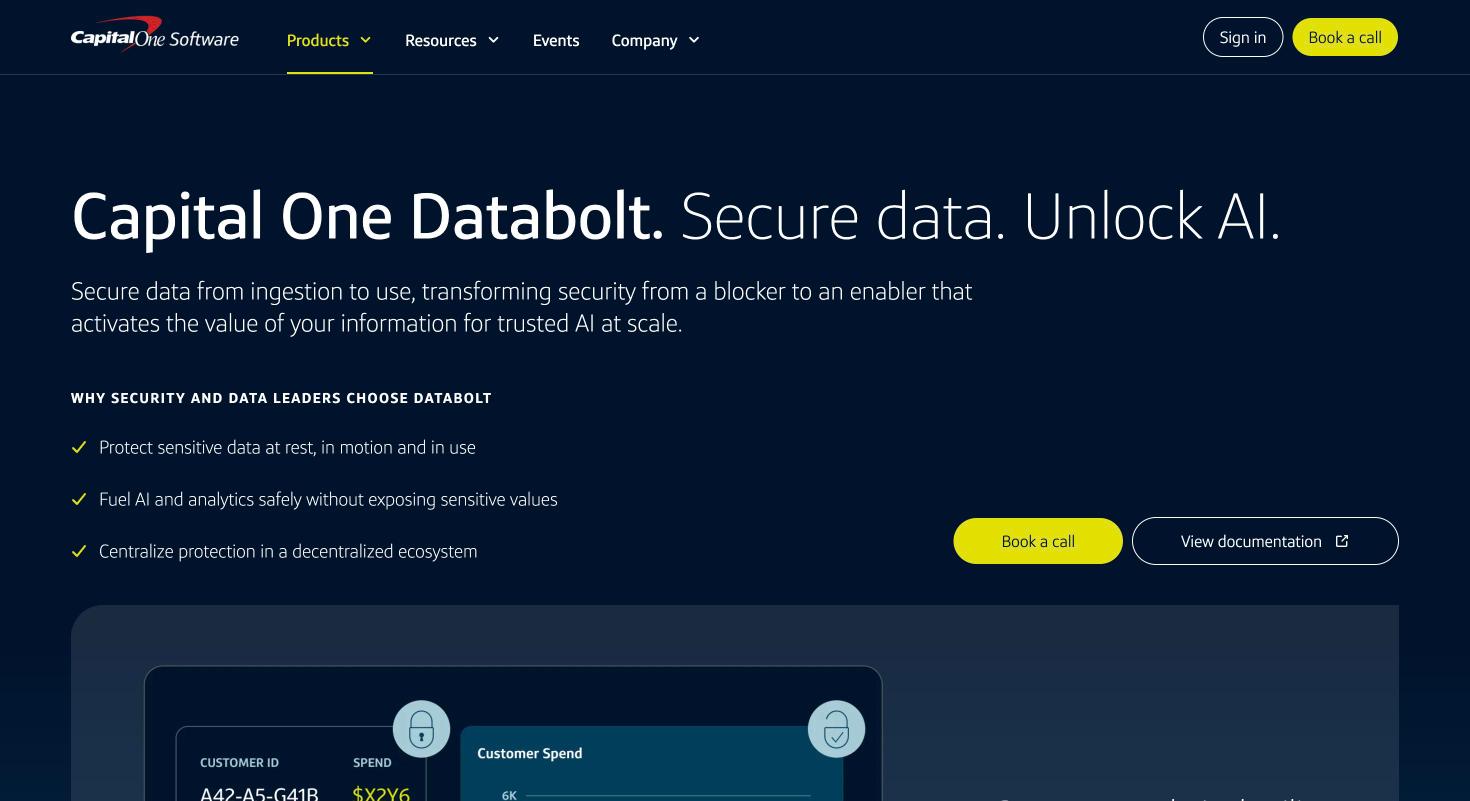
Capital One Databolt, from Capital One Software, tokenizes sensitive data while keeping its original format and data type, so models and applications keep working without re-coding. It combines tokenization with dynamic masking on read for field-level role-based access.
It runs inside the data platforms many Protegrity buyers already use: A Databricks integration built on Unity Catalog, and a Snowflake Native App on Snowpark Container Services, announced in May 2025.
Key features
- Format and type preservation: Keeps referential integrity so models and apps work without re-coding
- Field-level access: Role-based access using tokenization with dynamic masking on read
- Snowflake Native App: Data does not need to leave the customer’s Snowflake environment
- Throughput: Up to 8 million tokens per second on Snowpark Container Services, per Capital One
- Databricks: Built on Unity Catalog
- Centralized policy: Policy management across a decentralized data estate
Pricing
No prices are published. Capital One Software routes buyers to Book a Call.
Pros
- Runs inside Snowflake and Databricks
- High stated throughput
- Built by a bank for its own data, then sold to others
Cons
- No independent reviews on G2 or Capterra
- Focused on Snowflake and Databricks rather than application traffic
- Sales-led, with no free option
What users say
Reviews: No G2 or Capterra listing yet.
Watch for: If your sensitive data also flows through applications and LLM calls, plan how those paths are protected alongside the warehouse.
For tokenization across the wider data stack, see our guide to the best data tokenization tools.
Which Part of Protegrity Each Alternative Replaces
Protegrity covers several jobs, and most teams rely on one or two. Find the job you use Protegrity for, then see which alternatives handle it and how.
| What you use Protegrity for | Alternatives that handle it | How they handle it |
|---|---|---|
| Vaultless tokenization | Fortanix, OpenText Voltage SecureData, Thales CipherTrust | Fortanix and Voltage derive tokens with format-preserving encryption; Thales offers vaultless alongside vaulted |
| Format-preserving protection for existing schemas | OpenText Voltage SecureData, Fortanix, comforte TAMUNIO, Capital One Databolt | Tokens keep the original format and data type, so applications and analytics keep working |
| Protection inside data warehouses | Capital One Databolt, OpenText Voltage SecureData, Skyflow | Databolt runs inside Snowflake and Databricks; Voltage supports Snowflake, Teradata and Hadoop |
| Protecting data sent to LLMs and AI agents | Enigma Vault (NoPII), Skyflow, Baffle | NoPII tokenizes prompts and restores responses in the request path; Skyflow and Baffle protect AI data pipelines |
| Field-level protection for application data | Enigma Vault (Data Vault), Baffle, Thales CipherTrust | Data Vault through an API with exact-match lookup; Baffle without code changes; Thales through its platform |
| Mainframe and NonStop systems | comforte TAMUNIO, OpenText Voltage SecureData | comforte covers HPE NonStop; Voltage lists IBM z/OS |
| Masking and redaction | Thales CipherTrust, Baffle, Capital One Databolt | Static and dynamic masking, or dynamic masking on read |
Best Protegrity Alternative by Company Size
| Company size | Start with | Why |
|---|---|---|
| Startup or small team (50 or fewer) | Enigma Vault or Fortanix | Published pricing and a free plan, or a free trial; Protegrity’s small-business reviewers on G2 rate it 3.8, its lowest score by company size |
| Mid-market (51–1,000) | Enigma Vault or Baffle | Enigma Vault scores 4.8 with mid-market reviewers on G2 and Baffle 4.8, against 4.3 for Thales |
| Enterprise (1,000+) | OpenText Voltage SecureData, Thales CipherTrust or Skyflow, with Enigma Vault NoPII for LLM features | Broad platform coverage and vault programs at scale; NoPII covers AI traffic without a platform rollout |
Protegrity vs Enigma Vault: Side by Side
Both keep sensitive values out of the systems that use them. They differ in how tokens are made, where protection runs and how you buy it.
| Feature | Protegrity | Enigma Vault |
|---|---|---|
| Tokenization model | Tokenization, masking and encryption across data platforms | Vault-based tokens with AES-256 and exact-match lookup on encrypted values |
| Native data platform protectors | Databricks SQL, Amazon EMR, Cloudera, Snowflake, Redshift, Athena | Not offered; protection runs through the API |
| AI and LLM protection | Semantic guardrails, agent controls and gateway protection | Enigma Vault NoPII: Tokenizes prompts, responses, tool calls and embeddings, and restores values |
| Deployment | Kubernetes; current Enterprise deployment is AWS-specific | Cloud API; NoPII self-hosted edition on Enterprise |
| Pricing | Not published; demo first | Published: Free Lite, then $49, $249 and $499 a month per product |
| Free option | AI Developer Edition SDKs on GitHub | Free Lite plans on Data Vault and NoPII |
| Compliance | Audit dashboards for frameworks such as SOC 2 and HIPAA | PCI DSS Level 1 and SOC 2 Type II; PCI AOC, SOC 2 report and DPA on paid plans |
| G2 rating | 4.5/5 from 14 reviews | 4.4/5 from 6 reviews |
If you need native protection inside Databricks, Snowflake or Cloudera across a large estate, Protegrity is built for that. If you want to protect application fields and LLM traffic with a visible price and start this week, Enigma Vault covers it directly.
How to Choose a Protegrity Alternative
Answer these questions in order. Each one narrows the list.
1. Is most of your sensitive data in a warehouse or lakehouse? Look at Capital One Databolt for Snowflake and Databricks, or OpenText Voltage SecureData for Teradata and Hadoop.
2. Is it in your own applications and databases? Look at Enigma Vault’s Data Vault, an API that encrypts fields and still lets you search them, or Baffle, which protects databases without code changes.
3. Is it flowing into LLMs and AI agents? Look at Enigma Vault NoPII, a privacy proxy that tokenizes customer details before they reach the model and puts them back in the answer, or Skyflow for a wider vault program.
4. Do you need vaultless tokens? Choose Fortanix, OpenText Voltage SecureData or Thales CipherTrust.
5. Do you run mainframe or HPE NonStop systems? Look at comforte TAMUNIO or OpenText Voltage SecureData.
6. How quickly do you need a price? Enigma Vault publishes every plan, and Fortanix offers a free trial. The others start with sales.
Best Protegrity Alternative for Your Use Case
| Your use case | Best fit | Why it fits |
|---|---|---|
| Protecting customer fields in your own app | Enigma Vault (Data Vault) | AES-256 tokens with exact-match lookup, free to start |
| Keeping PII out of LLM prompts and RAG | Enigma Vault NoPII | Tokenizes before the model provider, restores in the response |
| Vaultless tokens with HSM-backed keys | Fortanix | Format-preserving encryption with FIPS 140-2 Level 3 HSMs |
| Mainframe, Hadoop and Teradata estates | OpenText Voltage SecureData | The broadest legacy and big data platform list |
| Already on Thales keys and HSMs | Thales CipherTrust Tokenization | Vaulted or vaultless tokenization in the same platform |
| Banks and processors on HPE NonStop | comforte TAMUNIO | Format-preserving protection plus NonStop security |
| A company-wide privacy vault program | Skyflow | Vault plus AI controls and the longest certification list |
| Existing databases without code changes | Baffle | Masking, tokenization and encryption applied transparently |
| Data that lives in Snowflake and Databricks | Capital One Databolt | Runs inside the platform, with dynamic masking |
Why Choose Enigma Vault as Your Protegrity Alternative
Teams leave Protegrity for three reasons we cover above: Pricing you only get from sales, an Enterprise Edition whose current deployment is AWS-specific, and a 3.8 rating from small-business reviewers on G2. Here is how Enigma Vault answers each need:
| What you need | How Enigma Vault delivers it |
|---|---|
| A cost you can plan for | Data Vault and Enigma Vault NoPII both start free, and paid plans start at $49 a month, all listed on the pricing page |
| Tokenization that keeps search working | Data Vault encrypts fields with AES-256 and keeps exact-match lookup on encrypted values |
| Protection for AI features | Enigma Vault NoPII tokenizes prompts, tool calls and embeddings before they reach the model provider, then restores real values in the response |
| No data leaks on failure | If NoPII cannot tokenize a request, it blocks it |
| Audit-ready compliance | A PCI DSS Level 1 and SOC 2 Type II vault, with the PCI AOC, SOC 2 report and DPA on paid Data Vault plans, and a BAA on Enterprise |
| Deployment choice | Cloud API, EU data residency as an add-on, and a self-hosted NoPII edition on Enterprise |
Enigma Vault also scores 4.8 with mid-market reviewers on G2 and 4.8 on Capterra. Start with one field or one AI workflow on the free plan and test it on your own data.
See Enigma Vault pricing, or request a demo to walk through your use case with the Enigma Vault team.
