


The best Limina alternatives for 2026: 1. Enigma Vault NoPII, 2. Tonic Textual, 3. Google Cloud Sensitive Data Protection, 4. Presidio, 5. Protecto, 6. Azure AI Language PII Detection, 7. Skyflow, 8. OpenAI Privacy Filter, 9. Protegrity, 10. Amazon Comprehend.
Limina, formerly Private AI, is a data de-identification platform. It detects PII, PHI and payment data across 50+ entity types in 52 languages, in text, PDFs, images, audio and structured data, and lets you redact, pseudonymize, tokenize reversibly or replace with synthetic data (source). It runs as a container in your VPC or on-premises. Limina itself publishes head-to-head pages against five of the products below (source).
For protecting live AI traffic without running a container, the best alternative is Enigma Vault NoPII, which publishes every plan and starts free. For de-identifying documents, datasets and recordings, these are the strongest options:
- Tonic Textual: Best for consistent synthetic data across documents and audio (G2 rating 4.2 from 38 reviews, across Tonic products)
- Google Cloud Sensitive Data Protection: Best for metered de-identification on Google Cloud (G2 rating 4.2 from 12 reviews)
- Presidio: Best for engineering teams that want free, open-source detection
- Protecto: Best for on-premises masking for AI agents
Every rating in this guide links to the product’s G2 or Capterra page, and every review quote links to the review itself.
Top 10 Alternatives to Limina at a Glance
| Provider | Best for | How it protects data | Deployment | Starting price | G2 rating | Our score (/5) |
|---|---|---|---|---|---|---|
| Enigma Vault NoPII | Protecting Live LLM Traffic Without Running a Container | Tokenizes LLM traffic, restores values | Hosted; self-hosted on Enterprise | Free, then $49/mo | 5.0/5 (1) | 4.0 |
| Tonic Textual | Consistent Synthetic Data Across Documents and Audio | Redaction and consistent synthesis | Cloud or self-hosted | Pay-as-you-go per 1,000 words | 4.2/5 (38) | 3.9 |
| Google Cloud Sensitive Data Protection | Metered De-Identification for Teams on Google Cloud | Inspection, redaction and tokenization API | Google Cloud | 1 GiB free, then $3/GiB | 4.2/5 (12) | 3.7 |
| Presidio | Engineering Teams That Want Free, Open-Source Detection | Open-source detection and anonymization | Self-run | Free (MIT) | Not listed | 3.6 |
| Protecto | On-Premises Masking for AI Agents | Format-preserving tokens for AI agents | SaaS, on-premises, air-gapped | Contact sales | No reviews yet | 3.4 |
| Azure AI Language PII Detection | Microsoft Shops Redacting Text, Transcripts and Documents | Detection and redaction API | Azure or containers | 5,000 records free, then per record | 4.3/5 (78) | 3.2 |
| Skyflow | De-Identification With Re-Identification for Authorized Use | Detection, tokenization and re-identification | Hosted vault on AWS | Contact sales | No reviews yet | 3.1 |
| OpenAI Privacy Filter | A Free, Open-Weight Model You Run Locally | Open-weight detection model | Local | Free (Apache 2.0) | Not listed | 3.1 |
| Protegrity | Enterprise Data Platforms That Need Tokenization at Scale | Vaultless tokenization and masking | Enterprise platform | Contact sales | 4.5/5 (14) | 3.0 |
| Amazon Comprehend | English and Spanish PII Detection on AWS | PII detection and batch redaction | AWS | Per 100-character unit | 4.3/5 (86) | 3.0 |
Protect PII in your AI features without running a container. Enigma Vault NoPII tokenizes sensitive values before they reach the model provider and restores them in the response. Your first million protected tokens each month are free.
TL;DR
- Enigma Vault NoPII (4.0/5): A hosted proxy for live LLM traffic, free for 1M tokens a month, then $49.
- Tonic Textual (3.9/5): Consistent synthetic replacement across text, PDFs, Office files and audio; cloud or self-hosted.
- Google Cloud Sensitive Data Protection (3.7/5): A metered API for redaction and tokenization with a free monthly allowance.
- Presidio (3.6/5): Free, open-source detection you deploy and maintain yourself.
- Protecto (3.4/5): Format-preserving tokens for AI agents, deployable on-premises and air-gapped.
- Azure AI Language PII Detection (3.2/5): Redaction for text, conversations and documents, in Azure or in containers.
- Skyflow (3.1/5): Detection and tokenization across text, audio and images, with re-identification for authorized use.
- OpenAI Privacy Filter (3.1/5): A free, open-weight model with eight PII categories that runs locally.
- Protegrity (3.0/5): Enterprise tokenization and masking for structured data platforms.
- Amazon Comprehend (3.0/5): PII detection for English and Spanish text, priced per 100 characters.
Why Teams Look for Limina Alternatives
Limina is strong where it matters most for de-identification: 52 languages, 50+ entity types, audio and images, and a container that keeps data inside your infrastructure. The reasons buyers still evaluate alternatives are about cost visibility, the free tier and operating effort.
- Paid pricing needs a quote: Batch is volume pricing on request, and Enterprise is custom with committed volume (source).
- The free tier is small: Starter allows up to 75 API calls a day at 10 a minute, with files capped at 250KB for txt, json, csv and xml, and 4MB for other types (source).
- You run the container: Self-hosting is a strength for data sovereignty, and it is also infrastructure your team has to deploy, scale and upgrade.
- Reviewers mention cost: One G2 reviewer calls it quite pricey (source).
If those points match your evaluation, the alternatives below sort by the job you need done.
Redaction, Synthesis or Tokenization: Pick the Method First
Limina offers all three methods. Most alternatives offer one or two, so start from what happens to the data next.
| Method | What replaces the value | Can the original come back? | Best for | Alternatives that offer it |
|---|---|---|---|---|
| Redaction | A placeholder or nothing | No | Sharing documents, breach reporting | Presidio, Amazon Comprehend, Azure, Google Cloud, OpenAI Privacy Filter |
| Synthetic replacement | A realistic fake value | No | Training data, analytics, test data | Tonic Textual |
| Reversible tokenization | A consistent token | Yes, for authorized users | Live AI features, RAG, agents | Enigma Vault NoPII, Protecto, Skyflow, Protegrity, Tonic Textual |
See tokenization on a real message. The NoPII live demo shows what your backend, the model provider and NoPII each receive when a message contains a name, email or SSN.
How We Scored These Limina Alternatives
We scored every provider on the same six criteria, weighted for a team replacing or avoiding Limina. Weights sum to 100%, and the score in the table is the weighted result.
- Pricing transparency and free start (25%): Published prices and a free way to test on real data.
- Fit for AI applications (20%): Prompts, responses, RAG and agents.
- Detection breadth (20%): Entity types, languages and file formats.
- Deployment options (15%): Hosted, self-hosted, on-premises and air-gapped.
- Reversibility and consistency (10%): Consistent replacement and the option to restore values.
- Review evidence (10%): Rating and number of verified reviews on G2 and Capterra.
Weight detection breadth higher and Tonic Textual and Skyflow climb; weight on-premises deployment higher and Protecto and Presidio climb.
The 10 Best Limina Competitors and De-Identification Alternatives
Each entry covers what the product is, which part of Limina it replaces, what it costs, where it falls short, and what verified reviewers say.
1. Enigma Vault NoPII: Best for Protecting Live LLM Traffic Without Running a Container
- Starting price
- Free, then $49 a month
- Free tier or trial
- Lite: 1M protected tokens a month, no card
- Deployment
- Hosted proxy; self-hosted edition on Enterprise
- What it replaces from Limina
- De-identifying prompts, tool calls and embeddings in real time, with values restored in the response
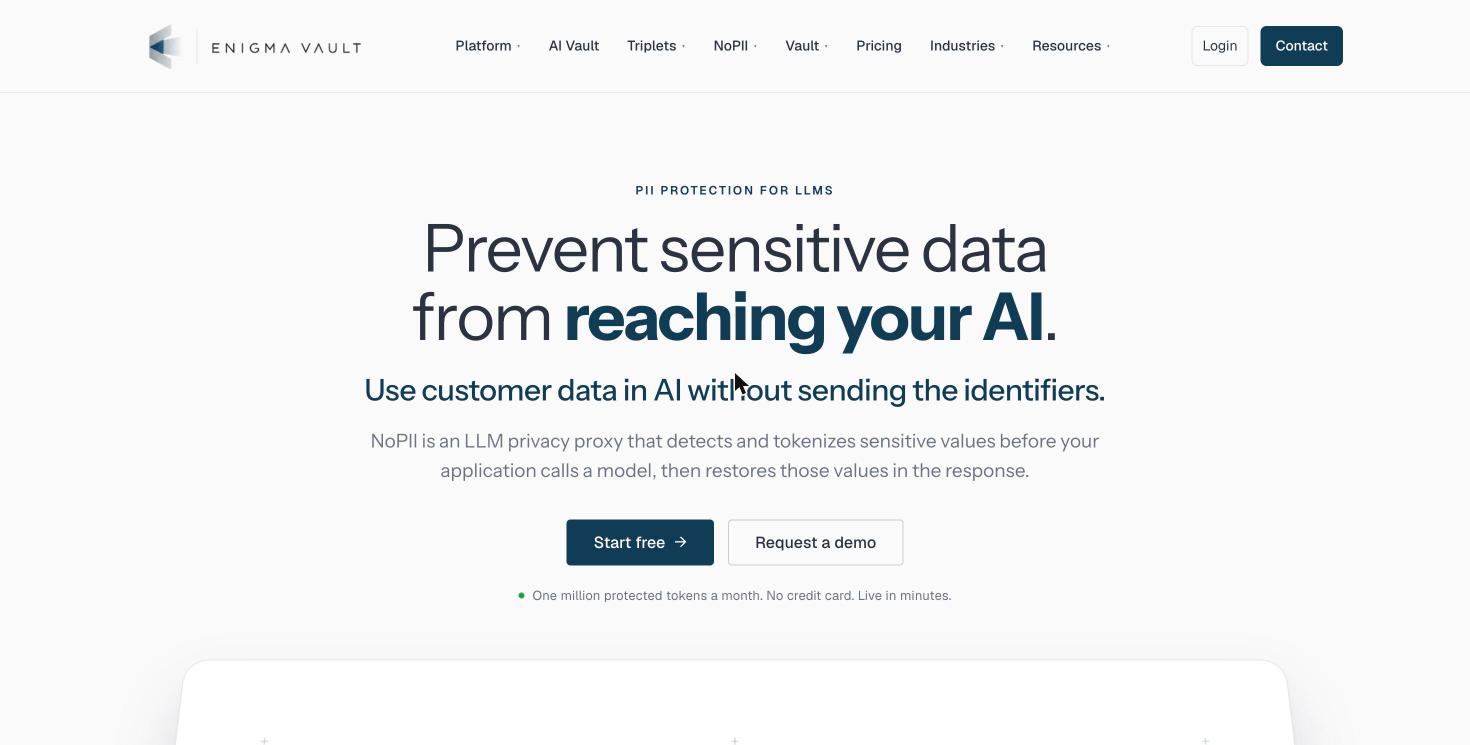
Enigma Vault NoPII is an LLM privacy proxy. Your application points its model client at the NoPII base URL, and NoPII swaps sensitive values for deterministic tokens before the request reaches the model provider, then restores them in the response.
For a Limina buyer, the difference is operational. Limina is a container you run in your VPC or data center and call from your pipelines; NoPII is a hosted proxy you switch on by changing one URL, with every price published. It covers one job, live LLM traffic, and does not do Limina’s batch, document, image or audio de-identification.
Key features
- Base-URL integration: Works across OpenAI, Anthropic, Google Gemini and six more providers
- Deterministic tokens: The same customer is the same token across turns and documents, so the model keeps context
- Round trip: Real values are restored in the response before your user sees it
- Agent and RAG coverage: Tool-call arguments and results, system prompts and the embeddings endpoint
- Detection: 11 entity types on by default, 25+ to opt into, and 14 pattern families of credentials
- Fail-closed: If tokenization fails, the request is blocked
Pricing
| Plan | Price | Protected tokens a month | Beyond the allowance |
|---|---|---|---|
| Lite | $0 | 1M (hard cap) | Upgrade prompt |
| Starter | $49/mo | 50M | $1.00 per million |
| Growth | $249/mo | 500M | $0.80 per million |
| Business | $499/mo | 2B | $0.60 per million |
| Enterprise | Custom | Custom commit | Includes the self-hosted edition |
Yearly billing saves on Starter, Growth and Business (pricing page).
Pros
- Nothing to host: A base-URL change replaces a container, a pipeline and the code that calls it.
- Its free tier is sized for a real pilot: One million protected tokens a month against Limina’s 75 API calls a day.
- Every tier is published, so you can price a year of usage before a sales call.
Cons
- It scans text only, so PDFs, images and call recordings are out of scope; Limina covers all of them.
- Names and places are detected in English and Hindi, far short of Limina’s 52 languages.
- Self-hosting is an Enterprise-only option, where Limina is self-hosted by default.
What users say
- Reviews: One G2 review so far: NoPII has a single 5/5 review on G2, written by a member of the Enigma Vault marketing team, so we do not quote it. The wider Enigma Vault listing has 6 reviews on G2.
Rated 5.0/5 on G2 from 1 review. No Capterra listing.
Watch for: If your Limina workload is batch de-identification of datasets or documents, NoPII is not a replacement; it is a separate layer for live AI traffic.
See it on a real message in the NoPII live demo.
Keep the context, lose the identifiers. NoPII tokenizes names, emails and account numbers before the model sees them and restores them in the answer. Start free with one million protected tokens a month.
2. Tonic Textual: Best for Consistent Synthetic Data Across Documents and Audio
- Starting price
- Pay-as-you-go, flat rate per 1,000 words
- Free tier or trial
- Not listed on the pricing page
- Deployment
- Tonic Cloud, or self-hosted with Kubernetes or Docker
- What it replaces from Limina
- De-identification and synthetic replacement for text, documents and audio used in AI training and sharing
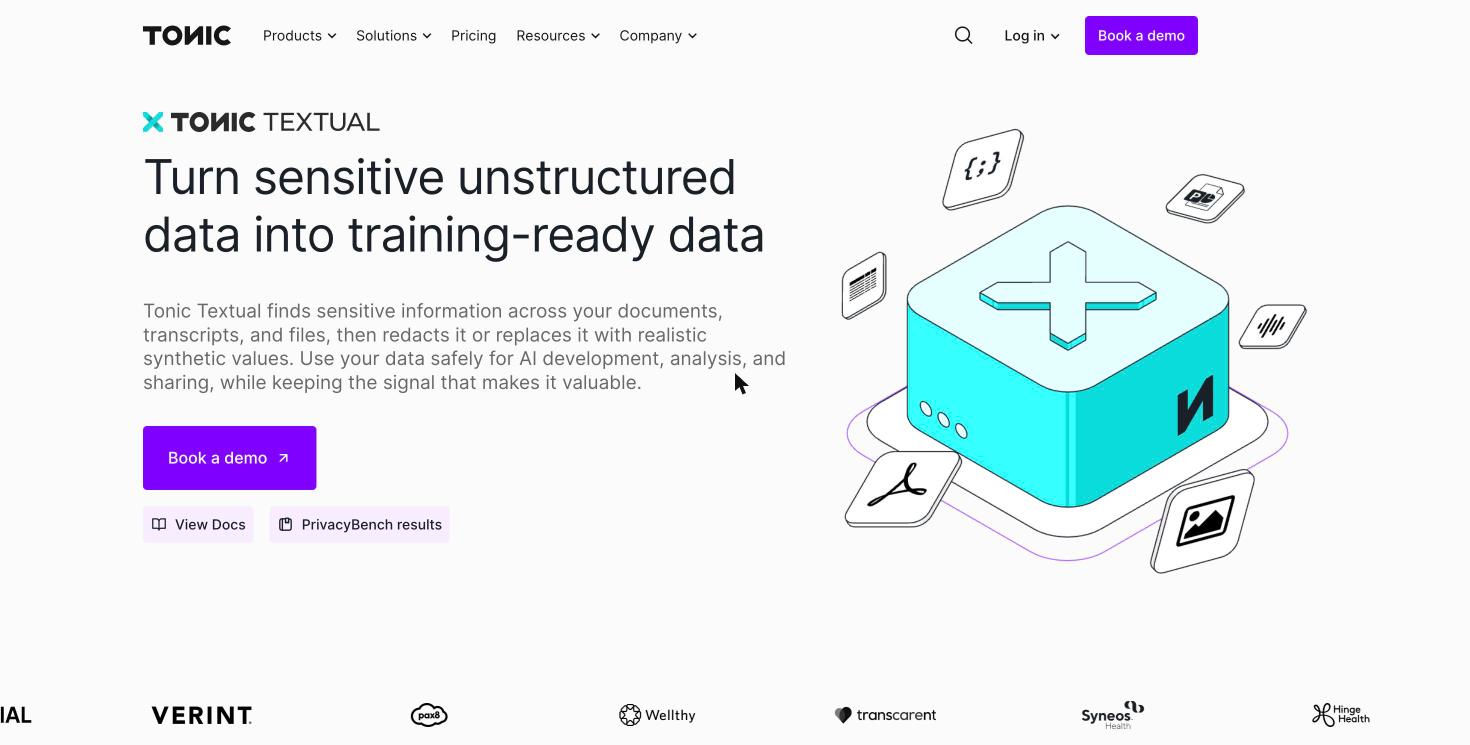
Tonic Textual de-identifies, redacts and synthesizes unstructured data, giving every person one synthetic identity that stays consistent across files and systems. Limina and Tonic each publish a head-to-head page against the other (source) (source), which makes it the most direct like-for-like swap on this list.
For a Limina buyer, Textual is the pick when the output has to stay realistic, for example a training corpus where names must still read like names.
Key features
- Detection with an LLM check: An LLM pass removes false positives after the first scan
- Custom entity types: Train detection on examples from your own data, such as project codenames
- Formats: Plain text, PDFs, scanned images, Word, Excel, PowerPoint, CSV, JSON, XML, HTML and audio
- Redaction, tokenization or synthesis: Automatic redaction, reversible tokenization, or consistent synthetic replacement
- RAG enrichment: Adds entity metadata tags to vector stores
- Deployment: Tonic Cloud or self-hosted with Kubernetes or Docker, plus Snowflake, AWS and Google Cloud marketplaces
Pricing
| Plan | Price | What it includes |
|---|---|---|
| Pay-as-you-go | Flat rate per 1,000 words (rate not shown) | Unlimited words scanned, unlimited users and custom detection models, usage dashboard |
| Enterprise | Custom | Tonic Cloud or self-hosted, dedicated account manager, onboarding support, BAAs |
Pros
- The widest file-format list among the alternatives here, including Office files and audio.
- Custom entity types let you catch internal identifiers such as project codenames.
- Cloud or self-hosted, so you can keep Limina’s data-stays-inside model.
Cons
- The per-word rate is not published, so you cannot model cost without talking to Tonic.
- A reviewer says it can lean toward over-masking.
- G2’s 38 reviews cover all Tonic products, not only Textual.
What users say
- Likes: Accurate identification and easy use: A reviewer singles out how effectively Textual identifies sensitive data (source), and another was impressed by how easy it was to use for anonymization (source).
- Dislikes: Over-masking and linking: One reviewer says it can over-mask (source), and another wants better linking of identical synthesized values (source).
Tonic.ai is rated 4.2/5 on G2 from 38 reviews across its products.
Watch for: Ask for the per-1,000-word rate in writing and model it against your monthly volume before you compare it with Limina’s committed-volume pricing.
3. Google Cloud Sensitive Data Protection: Best for Metered De-Identification for Teams on Google Cloud
- Starting price
- 1 GiB free a month, then $3.00 per GiB inspected
- Free tier or trial
- 1 GiB of inspection and 1 GiB of transformation a month
- Deployment
- Google Cloud managed service with API access
- What it replaces from Limina
- Detecting, redacting and tokenizing sensitive data through an API, billed by volume
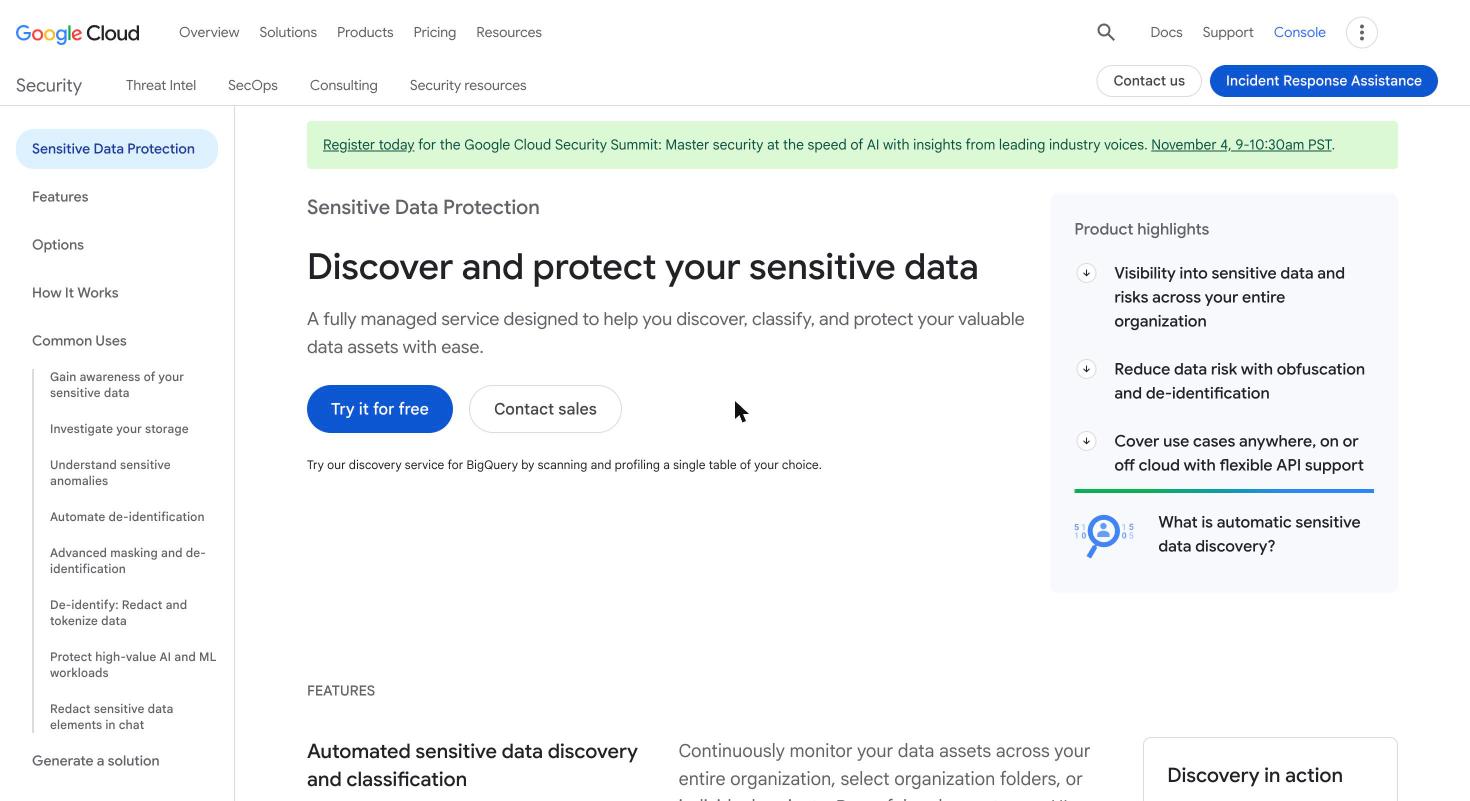
Sensitive Data Protection is Google Cloud’s managed service for discovering, classifying and de-identifying sensitive data, formerly Cloud DLP. Google’s own AI Overview for this search lists it as a Limina alternative, and both independent PII redaction roundups we checked include it (source) (source).
For a Limina buyer already on Google Cloud, it removes the container entirely: You call a managed API and pay per gibibyte.
Key features
- Discovery and classification: Profiles sensitive data across a Google Cloud organization, including BigQuery
- De-identification: Redaction and tokenization through the same API
- Chat redaction: Listed by Google as a common use case
- AI and ML workloads: Listed by Google as a common use case
- Hybrid use: API support for data on or off Google Cloud
Pricing
| Content method | 0 to 1 GiB | 1 GiB to 1 TiB | Above 1 TiB |
|---|---|---|---|
| Inspection | Free | $3.00 per GiB | $2.00 per GiB |
| Transformation | Free | $2.00 per GiB | $1.00 per GiB |
Monthly, per account.
Pros
- Every rate is published, with a free monthly allowance for testing.
- Redaction and tokenization from one API, with no infrastructure to run.
- Reviewers find the API easy to set up and keep current.
Cons
- Data has to be sent to Google Cloud for processing, the opposite of Limina’s stays-inside model.
- Per-GiB costs need modelling for large backfills.
- A reviewer finds the documentation heavy at first, and another notes that support is mostly paid.
What users say
- Likes: Easy setup and flexibility: One reviewer found the DLP API easy to set up (source), and another values its scalability and cost savings (source).
- Dislikes: Learning curve and paid support: A reviewer calls it complex the first time (source), and another notes that support is mostly paid (source).
Rated 4.2/5 on G2 from 12 reviews. No Capterra listing.
Watch for: If you chose Limina because data cannot leave your environment, a managed cloud API changes that answer.
4. Presidio: Best for Engineering Teams That Want Free, Open-Source Detection
- Starting price
- Free (MIT license)
- Free tier or trial
- Open source
- Deployment
- Self-run: Python, PySpark, Docker or Kubernetes
- What it replaces from Limina
- Self-hosted PII detection and anonymization for text, images and structured data
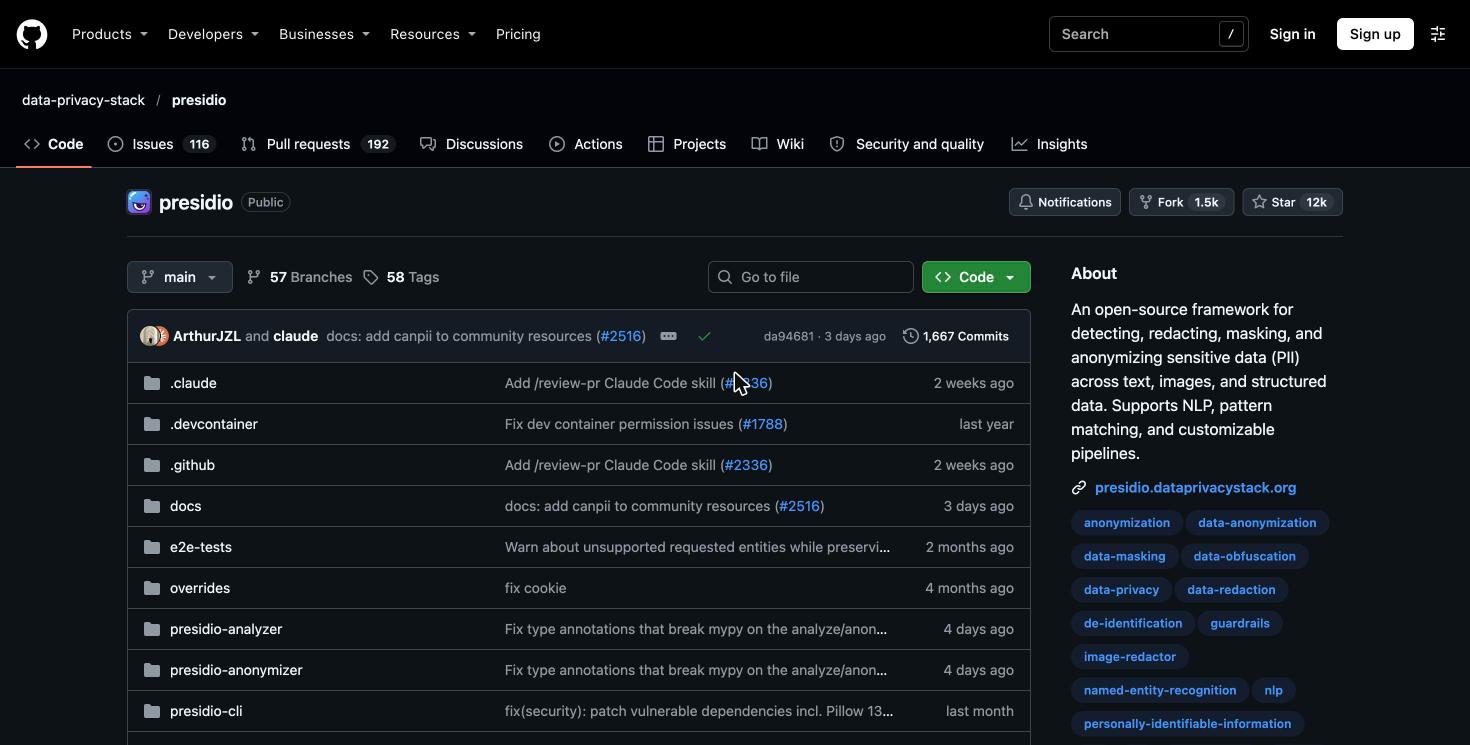
Presidio is an open-source framework for detecting, redacting, masking and anonymizing PII across text, images and structured data. It began at Microsoft and now lives in the data-privacy-stack GitHub organization. Limina publishes its own head-to-head page against it (source), and Google’s AI Overview for this search names it too.
For a Limina buyer, Presidio is the build option: It runs in your environment like Limina does, but your team assembles, tunes and maintains it.
Key features
- Detection: Recognizers that combine NLP, pattern matching and custom rules
- Image redaction: Removes PII from standard images and DICOM medical images
- Structured data: A module for tabular and structured data
- External models: Connects to other PII detection models
- Deployment: Runs from Python or PySpark through Docker to Kubernetes
Pricing
| Option | Price | Notes |
|---|---|---|
| Open source | Free (MIT license) | You host and maintain it |
Pros
- No license cost, and it runs anywhere you can run a container.
- Every recognizer is configurable, so you can add identifiers specific to your business.
- Image and DICOM redaction are included.
Cons
- Presidio’s own README warns there is no guarantee it will find all sensitive information (source).
- There is no vendor support, SLA or compliance documentation.
- A production system also needs storage, a proxy and audit logs, which you build yourself.
What users say
- Reviews: No review-site listing: Presidio has no G2 or Capterra listing; its GitHub issues and discussions are the main source of user feedback.
No G2 or Capterra listing.
Watch for: Budget the engineering time to tune recognizers on your own data; detection quality depends on that work.
- Starting price
- Contact sales
- Free tier or trial
- Demo
- Deployment
- SaaS, on-premises or private cloud, including air-gapped
- What it replaces from Limina
- Masking PII and PHI for AI agents, RAG and model calls inside your own environment, with values restored for authorized calls
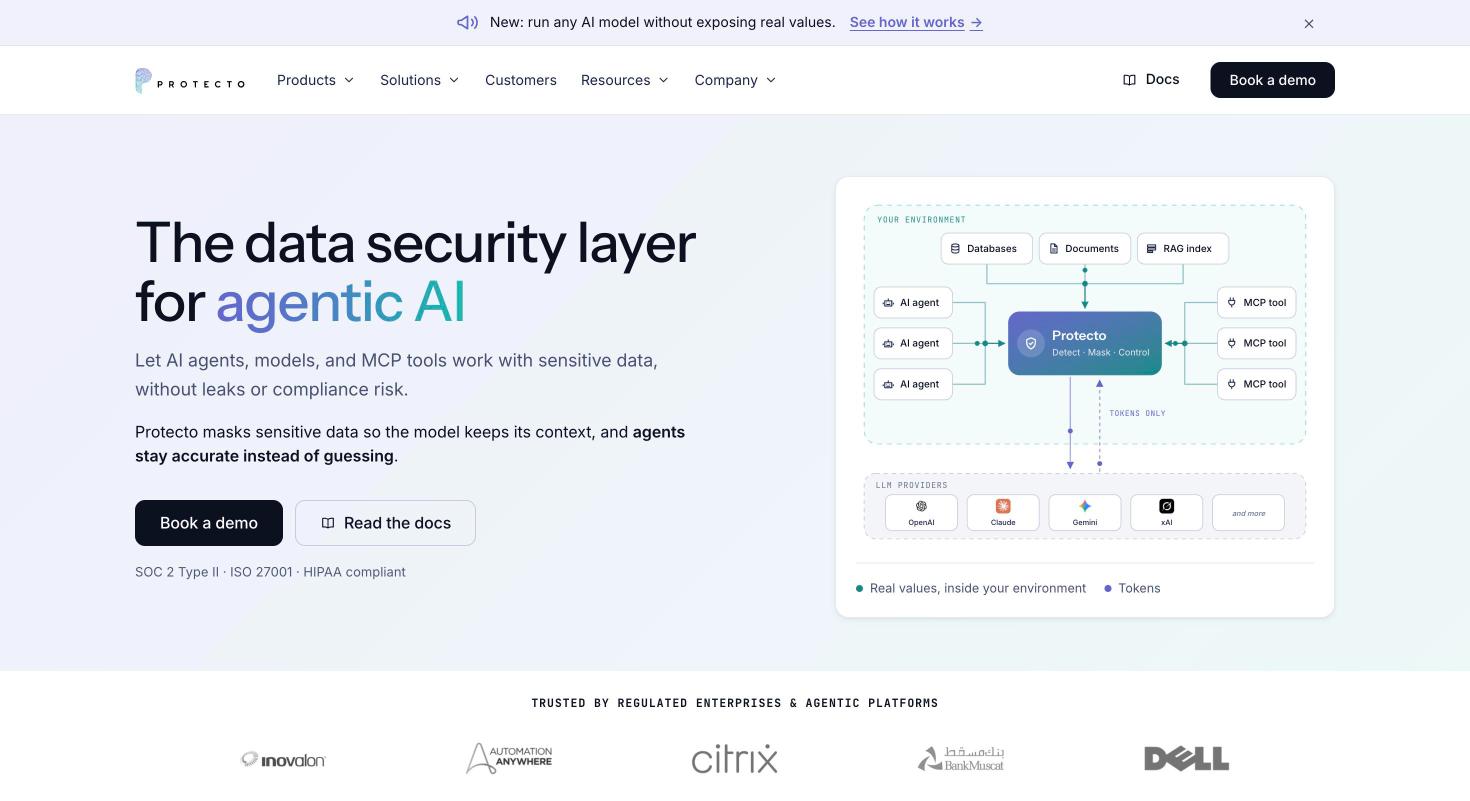
Protecto calls itself the data security layer for agentic AI. It maps each real value to the same format-preserving token every time it appears, and its Gateway resolves real values for authorized tool calls. Google’s AI Overview for this search lists it as a Limina alternative, and Protecto publishes its own Limina comparison page (source).
For a Limina buyer, Protecto keeps the on-premises model and adds controls built for agents and multi-step AI workflows.
Key features
- Format-preserving tokens: The same value maps to the same token everywhere, in the original format
- Gateway: Resolves real values for authorized tool and MCP calls
- Vault APIs: Direct integration for applications
- Access control: Shows each user, agent and task only the data it may see
- Deployment: SaaS, or on-premises and private cloud, including air-gapped
Pricing
| Option | Price | Notes |
|---|---|---|
| Protecto | Quote | The public pricing page currently returns a not-found page |
Pros
- Runs inside your own environment, including air-gapped setups, like Limina.
- Consistent tokens keep context for the model across a conversation.
- SOC 2 Type II, ISO 27001 and HIPAA are listed on its homepage.
Cons
- The public pricing page has been removed.
- There are no G2 reviews yet to check its claims against.
- It is built around AI workloads more than batch dataset de-identification.
What users say
- Reviews: No reviews yet: Protecto has a G2 listing with no reviews, so ask for reference customers in your segment.
No G2 reviews yet. Capterra lists Protecto with no reviews.
Watch for: Ask for current pricing in writing, since the public pricing page is gone.
For more options around this vendor, read our Protecto alternatives.
6. Azure AI Language PII Detection: Best for Microsoft Shops Redacting Text, Transcripts and Documents
- Starting price
- Billed per text record
- Free tier or trial
- 5,000 text records free a month
- Deployment
- Azure cloud, or connected and disconnected containers
- What it replaces from Limina
- Detecting and redacting PII in text, conversation transcripts and native documents
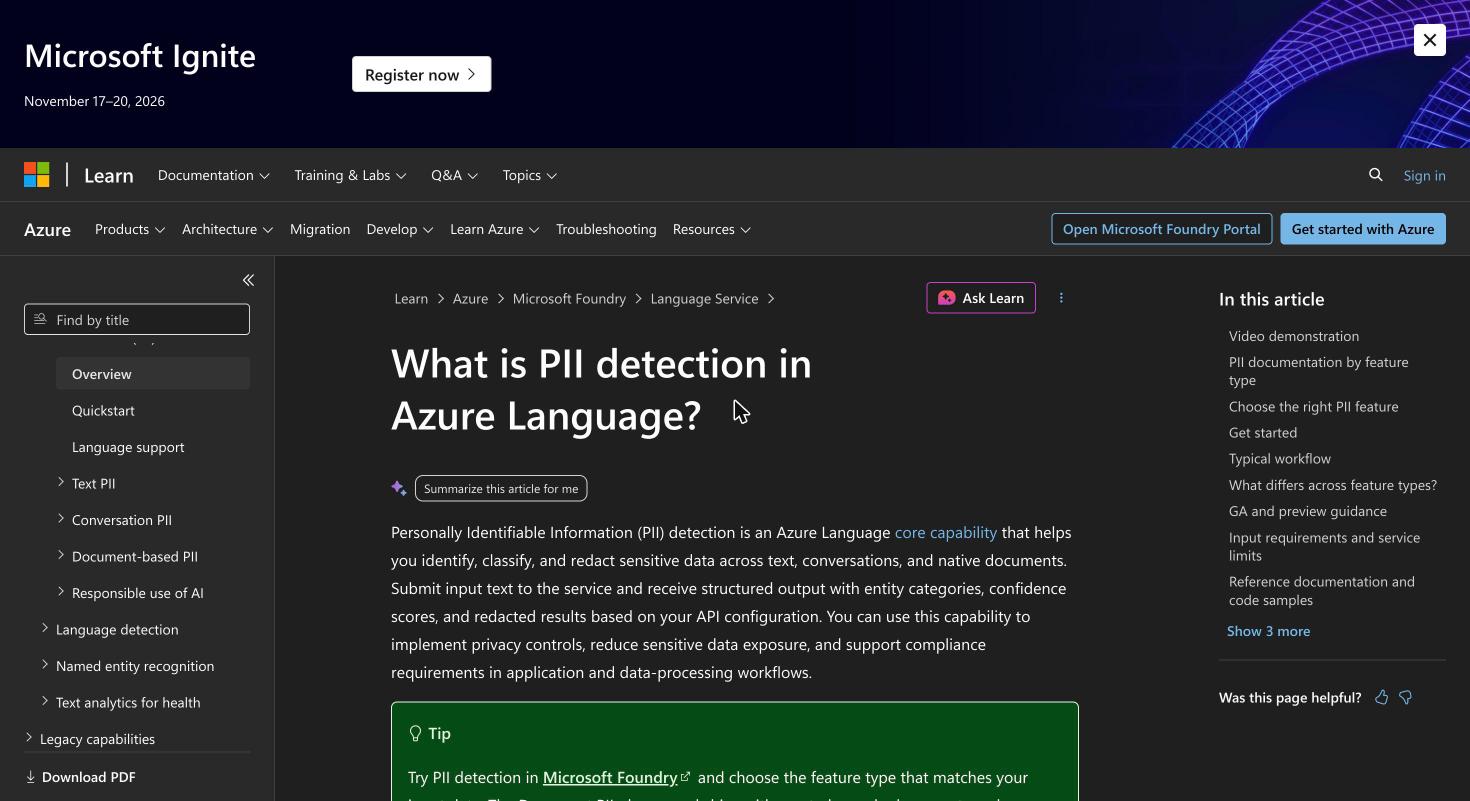
PII detection in Azure Language identifies, classifies and redacts sensitive data across text, conversations and native documents, returning entity categories, confidence scores and redacted output. Limina publishes its own head-to-head page against Azure Language Services (source).
For a Limina buyer in a Microsoft environment, Azure is notable because it can also run in containers, including disconnected ones.
Key features
- Text PII: Detects and redacts PII in plain text
- Conversation PII: Handles multi-turn chats and call transcripts
- Document PII: Redacts native documents, including PDF, and returns JSON metadata
- Customization: Entity types, masking styles and exclusions
- Containers: PII detection and text PII redaction can run in connected or disconnected containers
Pricing
| Tier | Price | Notes |
|---|---|---|
| Free | 5,000 text records a month | Free web tier |
| Standard | Per text record, in tiers | Rates shown in Azure’s pricing calculator |
| Containers | Connected or disconnected | PII detection and text PII redaction available |
Pros
- Covers text, conversations and documents in one service.
- A container option keeps processing inside your network, close to Limina’s model.
- A free monthly allowance for testing.
Cons
- Redaction only; the original values do not come back, where Limina offers reversible tokenization.
- Language support differs by feature, with shorter lists for conversation and asynchronous workloads.
- G2’s 78 reviews cover all Azure AI Language features, not only PII.
What users say
- Likes: Fast insight from large text volumes: A reviewer likes how quickly it extracts insights from large amounts of text (source).
- Dislikes: Learning curve and cost: One reviewer wants the advanced features to be easier to learn (source), and another flags pricing as a concern (source).
Azure AI Language is rated 4.3/5 on G2 from 78 reviews across all its features.
Watch for: Check the language list for the exact feature you need; text, conversation and document PII each support different languages.
7. Skyflow: Best for De-Identification With Re-Identification for Authorized Use
- Starting price
- Contact sales
- Free tier or trial
- Demo through the Try Skyflow form
- Deployment
- Hosted vault on AWS, with data residency support
- What it replaces from Limina
- Detecting and de-identifying sensitive data in text, audio and images, with re-identification for authorized use
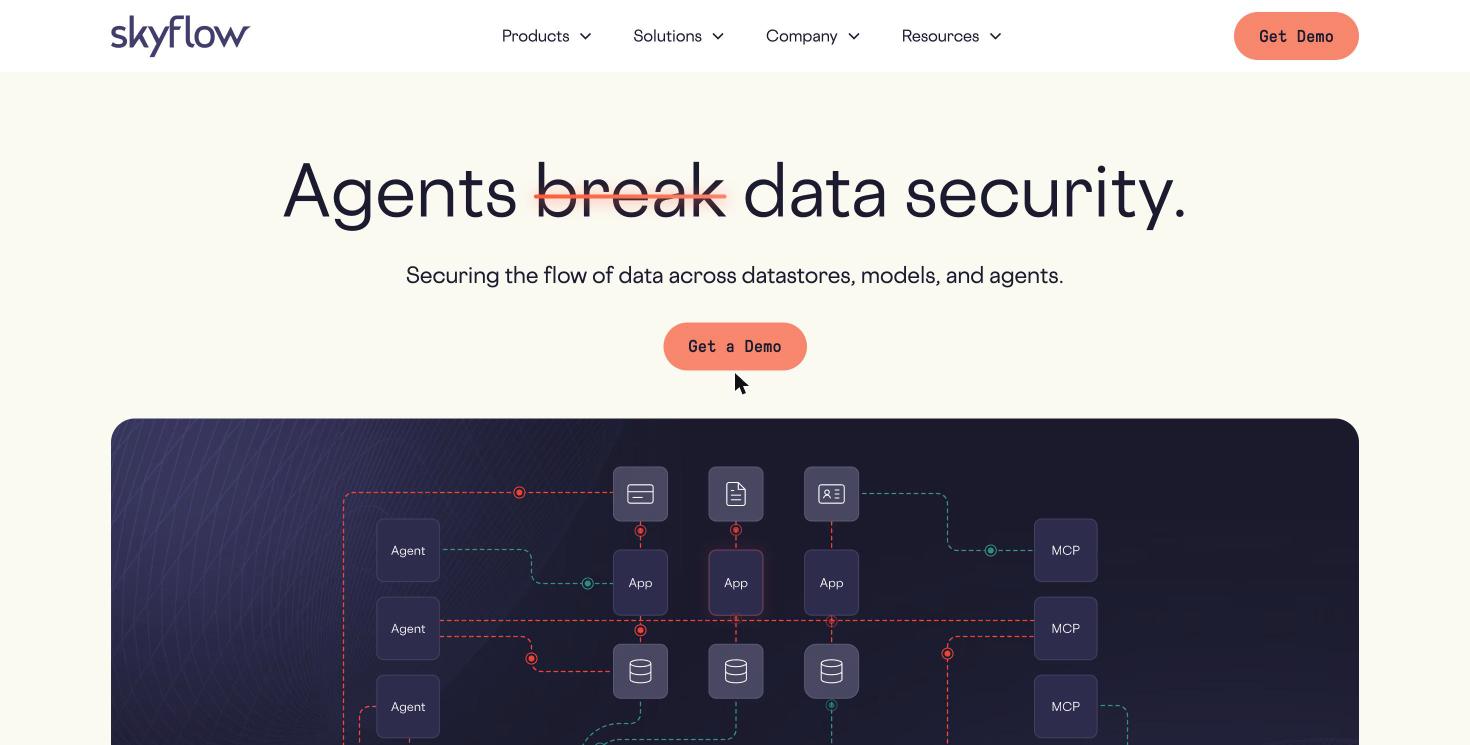
Skyflow is a data privacy vault that detects and tokenizes sensitive values at runtime in databases, documents and analytics platforms. Its data security page covers audio, video and text, and sensitive data is only re-identified for authorized use (source). G2 lists Skyflow for GenAI in the same Data De-Identification category as Limina.
For a Limina buyer, Skyflow is the option where de-identified values sit in a vault and can be released to authorized users, instead of being removed for good.
Key features
- Runtime detection: Detects and tokenizes sensitive values in databases, documents and analytics platforms
- AI lifecycle coverage: Detects and redacts during data collection, model training and fine-tuning
- Protection methods: Tokenization and polymorphic encryption
- Re-identification: Releases original values only for authorized use
- Data residency: Support for global data residency laws
- Integrations: AWS, Google Cloud, Snowflake, Databricks, Glean and ServiceNow
Pricing
| Option | Price | Notes |
|---|---|---|
| Skyflow | Quote | The Try Skyflow page is a demo request form |
Pros
- Original values can be released to authorized users from the vault.
- Covers audio and images as well as text, close to Limina’s format range.
- ISO 27001:2022, SOC 2 Type II and PCI DSS Level 1 are listed as certified on its security page.
Cons
- Its security page says services are deployed on AWS; there is no on-premises container like Limina’s.
- No published pricing.
- Skyflow for GenAI has no G2 reviews yet.
What users say
- Reviews: No reviews yet: Skyflow for GenAI has no G2 reviews yet, so ask for reference customers.
No G2 reviews for Skyflow for GenAI yet. No Capterra listing.
Watch for: If data must be processed on your own hardware, confirm Skyflow’s deployment options with its team before comparing it with Limina’s container.
Read our Protecto vs Skyflow comparison for more on Skyflow’s AI features.
8. OpenAI Privacy Filter: Best for A Free, Open-Weight Model You Run Locally
- Starting price
- Free (Apache 2.0)
- Free tier or trial
- Open weights
- Deployment
- Runs locally, on a laptop or in a browser
- What it replaces from Limina
- Detecting and redacting PII in text with a model you host and fine-tune yourself
OpenAI Privacy Filter is an open-weight model for detecting and redacting PII in text, released under the Apache 2.0 license. Limina publishes its own comparison page against it (source).
For a Limina buyer, it is a free detector rather than a platform: You get a model to run and fine-tune, and you build the pipeline around it.
Key features
- Small model: 1.5B parameters in total and 50M active, so it runs in a browser or on a laptop
- Long context: A 128,000-token window, with no chunking
- Eight categories: Account numbers, addresses, emails, names, phones, URLs, dates and secrets
- Fine-tuning: Adapt the model to your own labeled data
- Local tooling: A CLI for running, evaluating and fine-tuning
Pricing
| Option | Price | Notes |
|---|---|---|
| Open weights | Free (Apache 2.0) | You host and maintain it |
Pros
- Free, with open weights you can inspect.
- Small enough to run on ordinary hardware, fully inside your environment.
- Fine-tunable for the data you actually handle.
Cons
- Eight categories, against Limina’s 50+ entity types.
- Changing what it detects means fine-tuning the model.
- No vendor support, audit trail or reversible tokens.
What users say
- Reviews: No review-site listing: OpenAI Privacy Filter has no G2 or Capterra listing; its GitHub issues are the main source of user feedback.
No G2 or Capterra listing.
Watch for: It detects PII in text; entity consistency across turns, restoring values and audit logging are yours to build.
Read our analysis of OpenAI Privacy Filter vs NoPII.
9. Protegrity: Best for Enterprise Data Platforms That Need Tokenization at Scale
- Starting price
- Contact sales
- Free tier or trial
- Free AI Developer Edition SDKs
- Deployment
- Enterprise platform; current Enterprise deployment is AWS-specific
- What it replaces from Limina
- Tokenization, masking and encryption across databases, data warehouses and AI workflows
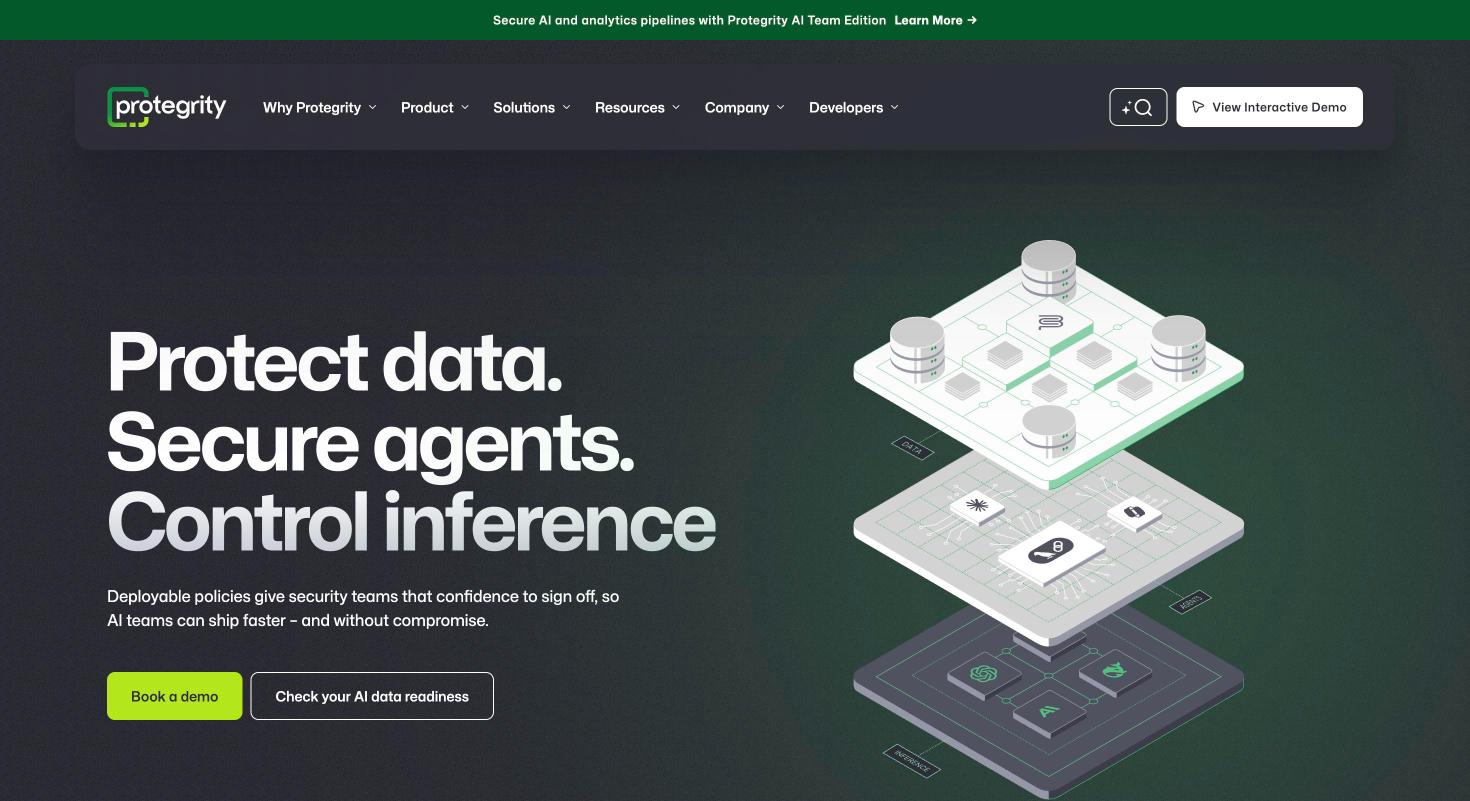
Protegrity is an enterprise data protection platform that tokenizes, masks and encrypts sensitive data across databases, data warehouses and AI workflows. Google’s AI Overview for this search lists it first among Limina alternatives, as a strong match for masking, tokenization and privacy compliance.
For a Limina buyer, Protegrity is the choice when the sensitive data sits in structured platforms such as Snowflake or Databricks rather than in free text.
Key features
- Vaultless tokenization: High-speed tokenization that preserves format and performance
- Cloud protectors: Protect data inside Snowflake, BigQuery, Redshift and other managed services
- Policy management: One set of rules for redaction, masking, encryption, tokenization and AI guardrails
- AI controls: Semantic encryption, inference controls and AI guardrails
- Editions: AI Developer, AI Team and AI Enterprise
Pricing
| Edition | Price | Notes |
|---|---|---|
| AI Developer Edition | Free | Downloadable SDKs on GitHub |
| AI Team Edition | Quote | Demo |
| AI Enterprise Edition | Quote | Current deployment is AWS-specific |
Pros
- Built for large structured data estates that Limina is not designed around.
- Native protectors mean data stays usable inside each platform.
- Rated 4.5 on G2 and 5.0 on Capterra.
Cons
- Not built for de-identifying free text, audio or images the way Limina is.
- The current Enterprise deployment is AWS-specific.
- No published pricing.
What users say
- Likes: Scale and support: A reviewer highlights vaultless tokenization that scales to large data protection efforts, deployed on-premises and in public cloud with little effort (source), and another praises fast fixes from a support team that knows its product (source).
- Dislikes: Price and usability: One reviewer finds the price range a little high (source), and another says user friendliness could improve (source).
Rated 4.5/5 on G2 from 14 reviews and 5.0/5 on Capterra from 1 review.
Watch for: Map where your sensitive data actually lives; Protegrity fits structured platforms, Limina fits unstructured content.
For more options around this vendor, read our Protegrity alternatives.
- Starting price
- Per 100-character unit, 3-unit minimum per request
- Free tier or trial
- 50K units a month for 12 months
- Deployment
- AWS managed service
- What it replaces from Limina
- Detecting and redacting PII in English or Spanish text through an AWS API
Amazon Comprehend is AWS’s natural language processing service. Its Detect PII API locates PII entities in English or Spanish text, and its Contains PII API flags whether a document holds PII at all. Limina publishes its own head-to-head page against it (source).
For a Limina buyer, Comprehend is the simplest swap if your data is English or Spanish text and already lives in AWS.
Key features
- Detect PII: Locates PII entities in English or Spanish text
- Contains PII: Flags whether a document holds chosen PII types, a cheap first pass
- Redaction: Produces redacted documents through asynchronous batch jobs
- Real-time analysis: Locates PII in real time through the API or console
- AWS integration: Reads documents from Amazon S3
Pricing
| Item | Price | Notes |
|---|---|---|
| Free tier | 50K units of text a month per API | For 12 months from your first request |
| Detect PII and Contains PII | Per 100-character unit | 3-unit (300-character) minimum per request |
| Above 100M units a month | Contact AWS | Volume pricing |
Pros
- Pay per use with a free tier, and nothing to deploy if you run on AWS.
- The largest G2 review base among the APIs here.
- Contains PII is a cheap way to triage which documents need redaction at all.
Cons
- PII detection covers English and Spanish text only (source).
- Redaction requires an asynchronous batch job.
- No images, audio or on-premises container.
What users say
- Likes: Fast text processing: Reviewers value how quickly it processes large amounts of text (source) and how it analyzes text without building models (source).
- Dislikes: Accuracy on specialist content: One reviewer found accuracy inconsistent for domain-specific content (source), and another says setup takes technical effort (source).
Rated 4.3/5 on G2 from 86 reviews across all Comprehend uses. Capterra lists it with no reviews.
Watch for: Language coverage. If any of your data is outside English and Spanish, Comprehend cannot replace Limina for it.
Limina vs Enigma Vault NoPII
Both protect sensitive data headed for AI models, from opposite directions. Limina is a de-identification engine you run and call; NoPII is a proxy that sits in your model traffic.
| Limina | Also considerEnigma Vault NoPII | |
|---|---|---|
| How you run it | Container in your VPC or on-premises | Hosted proxy; self-hosted on Enterprise |
| How you integrate | Call the API from your pipeline | Change your model client’s base URL |
| Methods | Redact, pseudonymize, reversible tokens, synthetic | Deterministic tokens restored in the response |
| Data types | Text, PDFs, images, audio, structured data | Text: messages, prompts, tool calls, embeddings |
| Languages | 52 | Names and places in English and Hindi; patterns in most languages |
| Free tier | 75 API calls a day | 1M protected tokens a month |
| Paid pricing | Quote | $49, $249, $499 a month |
| Next step | One million protected tokens a month free. No card needed. |
Limina covers far more data types and languages. NoPII is the faster path for one job: Keeping identifiers out of the prompts your application sends to a model.
How to Choose a Limina Alternative
Is the data live or at rest? Live prompts and agent calls point to NoPII, Protecto or Skyflow. Datasets, documents and recordings point to Tonic Textual, Presidio or a cloud API.
Can the data leave your environment? If not, your shortlist is Presidio, Tonic Textual self-hosted, Protecto, Azure containers or the OpenAI model. Google Cloud and Amazon Comprehend process data in their clouds.
Which languages and formats matter? Limina’s 52 languages and audio support are hard to match. Comprehend covers English and Spanish text only, and the OpenAI model covers eight categories.
Do you need the original values back? If yes, you need reversible tokenization: NoPII, Protecto, Skyflow, Protegrity or Tonic Textual.
Best Limina Alternative by Scenario
| Scenario | Best pick | Why |
|---|---|---|
| AI features that must show real values to users | Enigma Vault NoPII | Tokenizes in the request and restores in the response |
| Training data from documents and audio | Tonic Textual | Consistent synthesis across text, PDFs, Office files and audio |
| Already on Google Cloud | Google Cloud Sensitive Data Protection | Metered API with a free monthly allowance |
| No budget, strong engineering team | Presidio | Free and open source |
| Air-gapped AI agents | Protecto | On-premises and air-gapped deployment |
| Microsoft shop with transcripts | Azure AI Language PII Detection | Text, conversation and document PII, with containers |
| Broad detection with re-identification | Skyflow | Text, audio and images, with re-identification for authorized use |
| Free local model for an offline pipeline | OpenAI Privacy Filter | Open weights you can fine-tune |
| Structured data platforms | Protegrity | Protectors for Snowflake, BigQuery and Redshift, plus Databricks |
| English or Spanish text on AWS | Amazon Comprehend | Pay-per-use PII detection |
What Moving Off Limina Actually Involves
- Inventory your entity types: List the Limina entities and languages you rely on, and check each against the replacement before you sign.
- Decide what happens to existing output: Data already de-identified by Limina stays that way. If you used reversible tokens, plan how you will re-identify historical records.
- Re-run your accuracy test: Every engine misses different things. Run the same labelled sample through Limina and the replacement before cutting over.
- Check where processing happens: Moving from a container in your VPC to a cloud API changes your data flow, and may need a fresh review from compliance.
- Run both in parallel: Send the same traffic through both for a few weeks and compare what each catches.
Try Enigma Vault NoPII on Your Own Traffic
If the part of Limina you are replacing is protecting the prompts your application sends to a model, you can prove NoPII on your own traffic without deploying anything. The free plan is a permanent tier, not a trial, and switching is a base-URL change.
| What the free Lite plan includes | Detail |
|---|---|
| Protected tokens | 1M a month, hard cap, no credit card |
| Model providers | Every supported provider, including OpenAI, Anthropic and Google Gemini |
| Protection | PII detection and tokenization, with values restored in the response |
| Audit | Full audit trail with 7-day log history |
| Limits | 1 workspace, 1 user, 25 custom terms, 60 requests a minute per key, 1-day token retention |
| Upgrade path | Starter at $49 a month for 50M tokens, with no re-integration |
How to run a fair test in a week
- Pick the live workload: Choose an AI feature where Limina, or the pipeline around it, protects prompts before they reach a model.
- Point it at NoPII: Change the model client’s base URL to NoPII in a staging environment. There is no container to deploy.
- Use the same test set: Run the labelled sample you used to evaluate Limina, so detection results are comparable.
- Check what left your system: Use the audit trail to confirm each identifier reached the model provider as a token.
- Check the answers: Confirm real values come back in responses and that multi-turn conversations keep their context.
- Size the plan: Use the token count from the trial to choose a plan, and keep Limina for documents, audio and batch jobs if you need them.
When NoPII is not the right fit: If your work is de-identifying documents, images, audio or whole datasets, or you need 52 languages, Limina or Tonic Textual covers that better. NoPII is built for one job, live LLM traffic, and many teams run it alongside a de-identification engine.
Keep PII out of your model calls.
Book a demo to map your AI data path, or try the live demo first. If a de-identification engine on this list fits you better, we will say so.
More comparisons: Protecto alternatives, Nightfall alternatives and Enigma Vault NoPII vs Protecto.

