


The best Evervault alternatives for 2026: 1. Enigma Vault, 2. VGS, 3. Basis Theory, 4. Spreedly, 5. TokenEx / IXOPAY, 6. Skyflow, 7. PCI Proxy.
Teams evaluating Evervault alternatives usually think the choice is between holding card data and not holding it. That is not the choice. Every option here keeps raw card numbers out of your systems. The real question is narrower: Where does the data live, and what does it cost you to use it again?
Evervault answers that with dual custody. You hold encrypted cards without the keys, Evervault holds keys without your cards, and you pay per operation on top of a monthly base. It is a clean model with unusually transparent pricing.
If you are here, you are likely weighing whether a four-figure base plus metered decrypts, and the job of storing ciphertext yourself, still make sense for a workload that reads card data often or has grown past cards.
Disclosure: Enigma Vault publishes this comparison and appears in it, first. Every competitor fact comes from that vendor's own public pages checked on 16 October 2026. Where a vendor publishes nothing, we say so rather than guessing.
Evervault Alternatives Compared At A Glance
| Provider | Best for | Model | Data covered | Free tier | Published price | G2 rating | Overall (/5) |
|---|---|---|---|---|---|---|---|
| Enigma Vault | Starting free, covering more than cards | Vault-based | Cards, fields, files, intake | Yes, permanent | Free, then $49.99/mo | 4.4/5 (6) | 4.3 |
| VGS | Deepest payments tooling | Proxy plus vault | Cards, PII, files | Yes, to start | From $1,000/mo | 4.7/5 (47) | 4.3 |
| Basis Theory | A vault that holds the card for you | Cloud vault | Cards, bank data; PII on enterprise | No | From $995/mo | No reviews | 4.1 |
| Spreedly | Token portability across gateways | PCI Level 1 vault | Cards | No | From $750/mo | 4.4/5 (35) | 4.0 |
| TokenEx / IXOPAY | Multi-processor and card-present | Universal tokens | Cards, PII, PHI, ACH | Sandbox | Contact sales | 4.6/5 (17) | 3.4 |
| Skyflow | PII and PHI rather than cards | Data privacy vault | PII, PHI, cards | No | Contact sales | Too few | 3.3 |
| PCI Proxy | A proxy in front of many acquirers | Universal token vault | Cards | Free trial | Contact sales | No reviews | 3.2 |
TL;DR
- Enigma Vault (4.3/5): Four vaults covering cards, fields, files and customer intake, every tier published, permanent free tiers. Payments features are materially thinner.
- VGS (4.3/5): The deepest payments feature set here, delivered through a reverse proxy so you change less application code. Highest published entry price at $1,000 a month.
- Basis Theory (4.1/5): The clean custody swap. It takes the raw card, holds it in its own PCI Level 1 vault and returns a token, rather than returning ciphertext for you to store. From $995 a month, and the entry plan is US-only.
- Spreedly (4.0/5): PCI Level 1 vault from $750 a month with unlimited storage, built around owning your tokens across gateways.
- TokenEx / IXOPAY (3.4/5): Universal Tokens across processors and channels, plus PCI-validated P2PE for card-present. No public pricing.
- Skyflow (3.3/5): The move if your requirement turned out to be PII and PHI governance rather than payments. Longest certification list, no public pricing.
- PCI Proxy (3.2/5): Reverse-proxy universal token vault across many acquirers. No public pricing, free trial offered.
Why Teams Look For Evervault Alternatives
Evervault earns its place. Dual custody is a genuinely different security posture, Enclaves on AWS Nitro are real engineering, and it publishes per-operation rates almost nobody else in this market discloses. The reasons buyers evaluate alternatives are about cost shape, custody and scope, not the quality of the encryption.
- The base plus usage adds up: Platform is $995 a month before any usage, recommended for under 25,000 transactions a month. Encrypts, relays and functions are unlimited, but decrypts are $0.005 each, file decrypts $0.02 and fingerprints $0.005, so a read-heavy workload pays twice.
- You store the ciphertext: Evervault returns encrypted card data for you to hold in your own systems while the key stays with Evervault. Basis Theory, which competes directly for this keyword, characterises that as leaving more operational burden with your team. That is a competitor's framing, but the architectural difference is real and worth understanding before you choose.
- It is cards-first: Evervault's centre of gravity is payments, so if structured PII, documents or customer intake have entered your scope, much of the platform goes unused.
If those points match your evaluation, the alternatives below sort cleanly by how they answer them.
How We Evaluated These Evervault Alternatives
We scored every provider on the same six criteria, weighted for a team already running Evervault and deciding whether to move. Weights sum to 100%, and the Overall score in the table is the weighted result.
- Entry cost and pricing transparency (25%): What the first real tier costs, and whether it is published at all.
- Payments depth (20%): Network tokens, Account Updater, 3DS, BIN lookup, card-present.
- Custody model clarity (15%): Who holds the card, who holds the key, and what your systems end up storing.
- Processor independence (15%): Do tokens move between gateways, or lock to one?
- Coverage beyond cards (15%): Structured PII, files and intake.
- Compliance evidence (10%): What each vendor publishes on its own trust pages.
This is an editorial comparison published by one of the vendors in it. Re-weight it and the order moves: Raise coverage and drop payments depth, and Enigma Vault and Skyflow climb.
On review scores: G2 and Capterra ratings here were checked on each product's page on 16 October 2026, and every one is reported with its review count. An average drawn from six reviews and an average drawn from forty-seven are not the same claim.
Where a vendor has no published reviews, we say so plainly rather than filling the gap with something softer.
On PCI scope: Moving between PCI DSS Level 1 providers does not by itself change your scope. Scope follows your environment and integration, and your acquirer or a QSA confirms it.
The 7 Best Evervault Competitors And Card Tokenization Alternatives
Each entry below covers what the tool is built for, what it actually does in detail, what it costs or how to find out, and where it falls short. Scores come from the weighting above.
1. Enigma Vault
Best for: Teams for whom the $995 base or metered decrypts are the problem, or whose scope grew past cards.
Enigma Vault is a vault-based platform covering cards, structured fields, files and customer intake through one REST API, with every tier published and a permanent free tier on each vault.
For an Evervault buyer two things change. There is no monthly base to clear before you start: Card, Data and File Vault each have a permanent free tier, and the first paid tier is $49.99. And the vault holds the card, so your systems store a token rather than ciphertext you are responsible for.
The honest trade is payments depth. Evervault has network tokens, Account Updater, 3DS and BIN lookup. Enigma Vault does not.
Key features
- Card Vault: Hosted forms, Twilio Pay IVR or API capture, charge through any REST gateway via proxy
- Optional Luhn-passable tokens; CVVs held encrypted at most 30 minutes, then deleted
- Data Vault: AES-256 field encryption with exact-match lookup, batch to 5,000 secrets
- File Vault: Files to 5 GB, presigned URLs, WebSocket status
- Customer Vault: Branded no-login intake, staff inbox, e-signatures
- OAuth2 M2M auth, per-customer AES-256 keys, CSPRNG tokens with 128-bit entropy
- Live Swagger UI at api.enigmavault.io, US and EU regions
Pricing
| Vault | Lite | Plus | Premium |
|---|---|---|---|
| Card Vault | $0, 1,000 requests/mo | $49.99/mo, 20,000 | $249.99/mo, 250,000 |
| Data Vault | $0, 1,500 requests/mo | $49.99/mo, 30,000 | $249.99/mo, 400,000 |
| File Vault | $0, 5 GB/mo | $49.99/mo, 150 GB | $249.99/mo, 1 TB |
Usage beyond each tier is billed per request at published overage rates: $0.08, $0.04 and $0.02 per Card Vault request and $0.06, $0.03 and $0.01 per Data Vault request on Lite, Plus and Premium.
Billing runs through the AWS account you already have, so there is no new vendor for finance to onboard. Security does not change between tiers, free included.
Pros
- No monthly base to clear. Permanent free tiers, then $49.99, against Evervault's $995 plus usage
- Four data shapes under one integration, including intake, which nothing else here covers
- PCI DSS Level 1 Service Provider, SOC 2 Type II, BAA available, 99.99% uptime SLA
Cons
- The narrowest payments feature set of the payments-capable tools here. No Account Updater, no BIN lookup, no network token product.
- Public reviews are few, so there is less independent evidence to lean on than with the older vendors here.
- No self-hosted option. SaaS in US and EU regions only.
- Lite tiers cover roughly 1,000 to 1,500 requests a month.
What users say
- Likes: Simple API and clear PCI scope: A CEO reviewer rates Card Vault the best card tokenization option their team found, citing a simple API, no surprises on PCI DSS de-scoping, lower cost than other vendors, and support that added their domestic card type in under 24 hours. (source)
- Likes: Cards, personal data and files in one place: Another reviewer says the structured vaults make card data, personal information and multi-GB files easy to handle from one platform. (source)
- Dislikes: Pricing and documentation: One reviewer finds pricing a bit high for the product (source), and another sees room for more documentation (source).
Rated 4.4/5 on G2 from 6 reviews and 4.8/5 on Capterra from 4 reviews, checked 16 October 2026.
CVV, 3DS And Billing, Answered
| Question | Answer |
|---|---|
| Can the CVV be used for the first authorization? | Yes. A CVV captured in the hosted form is available for the authorization, then deleted after its first use. It is never held beyond 30 minutes and is never backed up. |
| Is 3-D Secure supported? | Card Vault does not run 3DS itself. |
| What does a request cost? | Card Vault includes 1,000, 20,000 or 250,000 requests a month, with overage at $0.08, $0.04 or $0.02 per request. |
| What do my systems store? | Unsaved cards expire on a time limit of up to 15 minutes; saved cards stay until you delete them through the API. Card data is backed up for 35 days, and the full card number is never returned to your systems, only used through the proxy. |
| Can we test the full flow for free? | Yes. The free Lite tier includes tokenization and the gateway proxy (1,000 requests a month), so you can run hosted form capture, a token and a proxied call to your gateway sandbox before paying anything. |
Watch for: No Enclave equivalent. If you run logic on encrypted data inside Evervault today, that pattern does not transfer.
There is no monthly base to clear first, so you can tokenize real cards and read the audit log the same afternoon. See the plans or talk to us.
2. VGS
Best for: Payments teams that want the fullest payments toolset with minimal application rework.
VGS runs a processor-agnostic vault behind a reverse proxy that aliases sensitive data before it reaches your systems, then re-inserts the real value in real time on the way out.
For an Evervault buyer the appeal is breadth. Where Evervault gives you encryption primitives and card tooling, VGS gives you a full payments stack. The trade is a proxy dependency in your request path.
Key features
- Reverse-proxy aliasing with real-time re-insertion
- Network tokens, Account Updater, 3DS, BIN lookup, account validation
- Wallet payments and agentic commerce tooling
- Processor-agnostic vault covering cards, PII and files
- AI Data Firewall
- VGS Collect and Control APIs
- Free tier to get started
Pricing
Plans start at $1,000 a month, with a free tier to begin.
Pros
- Deepest payments feature set in this comparison
- Less application rework than a direct vault integration
- A starting price is published, which most of this market does not do
Cons
- The highest published entry price here, above Evervault's base
- The proxy adds a network hop and an operational dependency in the payment path
- Weighted toward payments, so a widening PII requirement is a weak fit
What users say
- Likes: Fast integration and helpful support: A developer describes understanding the proxy quickly and moving their workflow onto it, with chat support singled out (source), and another reviewer credits the team for supplying the documentation needed to prove PCI compliance (source).
- Dislikes: Add-on fees, documentation and cost: Reviewers object to $40 for each extra CNAME (source), find some documentation out of date (source) and rate cost on the high side (source).
Rated 4.7/5 on G2 from 47 reviews, the highest in this comparison, checked 16 October 2026. No Capterra listing found.
Watch for: If you left Evervault over cost, VGS is not the answer. Its floor is higher.
For how proxied card flows work from capture through to settlement, read our guide to credit card tokenization.
3. Basis Theory
Best for: Engineering teams that want the vault to hold the card rather than hand back ciphertext, and can work in the US region.
Basis Theory is the cleanest custody swap from Evervault, and it actively competes for this keyword. It takes the raw card number, holds it in its own PCI Level 1 vault and returns a token, rather than returning encrypted data for you to store.
Basis Theory says Account Updater and network tokens are native to its vault, where on an encryption model they must be decrypted and passed between systems to use. That is a competitor's characterisation of Evervault, so test it against your own integration rather than taking it as given.
Key features
- Raw card held in a PCI Level 1 vault, token returned
- Network tokens and Account Updater native to the vault
- 3DS, smart routing and backup-PSP orchestration
- Token correlation across multiple tokens without accessing the PAN
- Proxy, Reactors and Elements
- PCI Attestation of Compliance included at the entry tier
Pricing
Plans start at $995 a month, including 20,000 tokens, with a production-ready PCI environment, a 1 MB payload limit and 24 hours of logs. Basis Theory describes the model as forecasting costs on architecture usage rather than per request.
The entry plan is US environment only, and PII and PHI options sit on the enterprise tier, which Basis Theory says answers 95% of PCI SAQ D.
Pros
- The vault holds the card, so your systems store a token rather than ciphertext
- Published entry price with a stated token allowance and a PCI AOC included
- Strong multi-PSP routing with no stated partner limitations
Cons
- At $995 the floor is level with Evervault's base, so this is a model change, not a cost saving
- US-only at the entry tier, which rules it out for EU data residency without moving up
- PII and PHI coverage requires enterprise
What users say
- Likes: No independent reviews yet: Basis Theory has listings on G2 and Capterra but no published reviews, so its own pricing and compliance pages carry more weight than usual.
- Dislikes: Nothing to validate against: With no peer feedback available, ask for reference customers in your own segment before you commit.
No published reviews on G2 or Capterra as of 16 October 2026.
Watch for: Usage-based rather than per-request forecasting changes how you model cost. Rebuild the estimate, do not assume it maps to your Evervault bill.
Holding a token rather than ciphertext changes what your own systems are responsible for. Our guide to card vault tokenization walks through that shift.
4. Spreedly
Best for: Merchants that want portable tokens across gateways at a lower published floor than Evervault.
Spreedly is an orchestration platform with a PCI Level 1 vault underneath it, aimed at merchants who would rather hold their own payment tokens than rent them from a processor.
Key features
- Unlimited vault storage on a flat monthly tier, so holding more cards never changes the invoice
- Universal and network tokenization across gateways rather than per provider
- Account Updater, keeping reissued cards usable without customer involvement
- PSP-agnostic routing with smart retries for second attempts through another processor
- Vault health insights on expiring and failing credentials
- 3D Secure 2 and fraud prevention tooling
- An agentic commerce kit for AI-initiated purchase flows
Pricing
The vault plan starts at $750 a month with unlimited storage, below Evervault's base. Orchestration features sit on a higher contact-sales tier.
Pros
- $750 published with unlimited storage, the lowest floor among the payments platforms here
- Token portability is the explicit product promise
- Strong compliance footprint including network token certification
Cons
- The orchestration layer, which is the real draw, needs a sales conversation
- Payments only. No PII, PHI or document coverage
- Two-tier structure means the published price may not be the price you pay
What users say
- Likes: One vault across many gateways: A founder values one centralized vault while processing across more than a hundred gateways (source), and another reviewer praises quick, detailed support (source).
- Dislikes: Slow dashboard and per-call pricing: Reviewers report a slow dashboard (source), per-API-call pricing that makes automated testing costly (source), and one long-time customer describes a sudden 3x price increase (source).
Rated 4.4/5 on G2 from 35 reviews and 4.5/5 on Capterra from 13 reviews, checked 16 October 2026.
Watch for: Price the tier you actually need before comparing it to your Evervault bill.
For the wider payments field ranked on architecture and published price, see the best payment tokenization software.
5. TokenEx / IXOPAY
Best for: Merchants running several processors and channels, including in-person card acceptance.
TokenEx, absorbed into IXOPAY, centres on Universal Tokens that travel between processors and channels without being re-issued, plus PCI-validated point-to-point encryption for in-person acceptance.
The company says outbound replacement of a token with real card details keeps that data clear of your own systems. Treat that as their characterisation and let your acquirer or QSA confirm what it means for your scope.
Key features
- Universal Tokens built to move between processors and channels without re-vaulting
- PCI-validated point-to-point encryption for card-present, which no other option on this list carries
- Network tokens available alongside the universal token model
- Browser and iframe encryption at capture, so raw cards bypass your servers
- Coverage stretching past cards into PII, PHI and ACH data
- Acquirer PCI tooling for in-house compliance programmes
Pricing
IXOPAY publishes no tokenization rates. Getting a number means using one of three routes on the site: Get Sandbox Access, Get a Demo, or Contact Sales.
Start with sandbox access. Coming from per-operation pricing you will already know your volumes precisely, and quoting against those beats quoting against an estimate.
Pros
- Universal Tokens unify payment data across a multi-PSP setup
- P2PE covers card-present, which most of this list does not
- Long published certification list
Cons
- No public pricing, so you cannot compare against Evervault's published rates without a sales call
- Mid-transition from TokenEx to IXOPAY, which makes trust pages harder to track down
- Payments-first, so documents and general PII fall outside it
What users say
- Likes: Gateway-agnostic tokens at a lower cost: A reviewer values the secure payment iframe, tokens that move across gateways and a per-token cost below other providers (source), and another praises fast ticket resolution (source).
- Dislikes: Reporting limits: One reviewer cannot build customer-specific reports or see usage history past 30 days (source), and another finds forced password resets a hassle (source).
Rated 4.6/5 on G2 from 17 reviews (listed as TokenEx / IXOPAY), checked 16 October 2026. The Capterra listing has no reviews yet.
Watch for: The TokenEx to IXOPAY migration. Check which legal entity appears on your contract and on the AOC you will be relying on.
For the PCI picture across every option in this category, read the best PCI DSS compliant tokenization software.
6. Skyflow
Best for: Enterprises whose requirement turned out to be PII and PHI governance, not card payments.
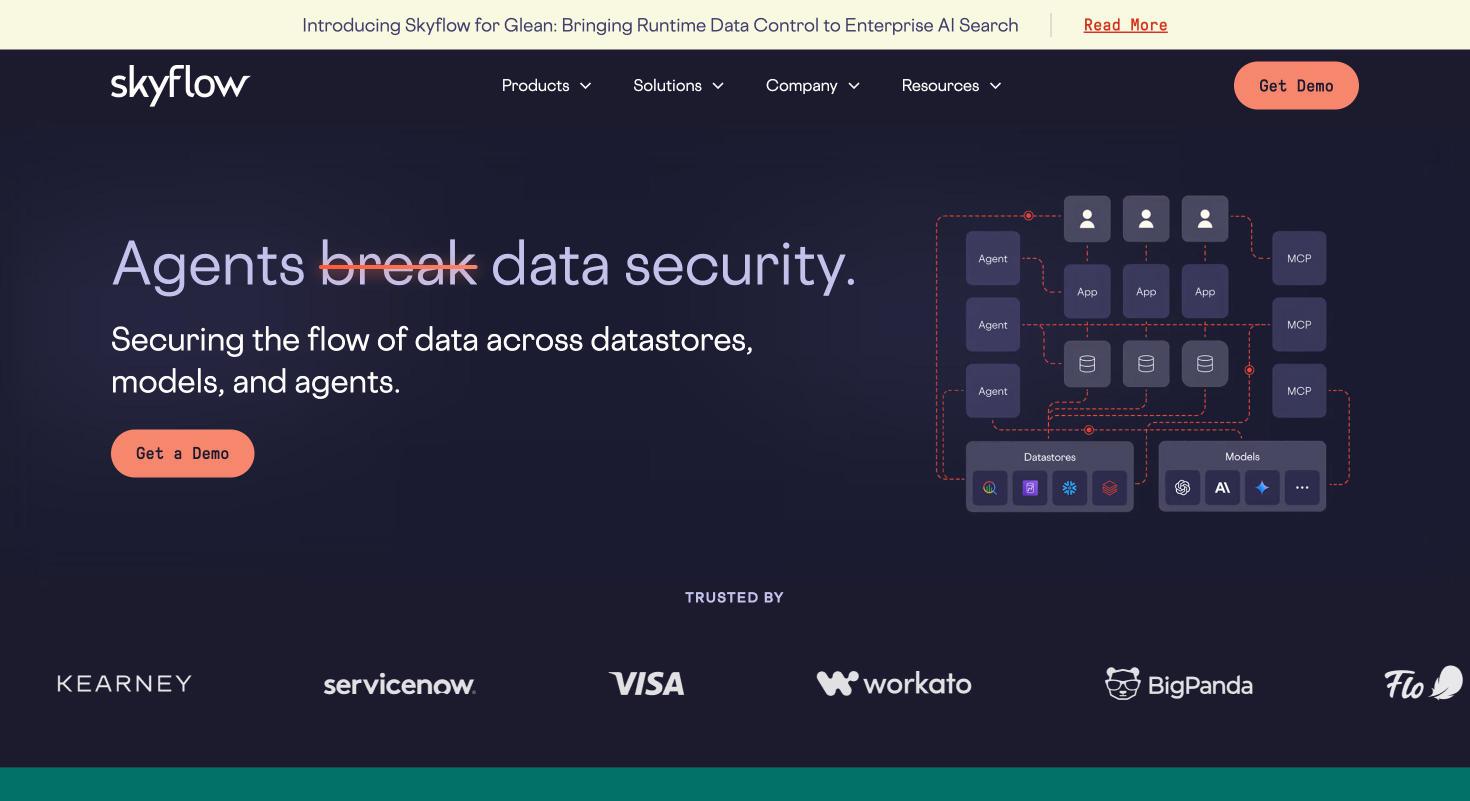
Skyflow keeps PII, PHI and payment data behind field-level access policies, and spent 2026 repositioning around what it now calls runtime AI data control.
Skyflow publishes ISO 27001:2022, SOC 2 Type II and PCI DSS Level 1 certifications, and states it is HIPAA assessed and eligible and GDPR assessed and compliant.
Key features
- A data privacy vault that isolates PII, PHI and payment data behind field-level access policies
- Polymorphic encryption, so the same field can return masked, redacted or plaintext depending on who is asking
- Built-in detection, de-identification and redaction tooling for finding sensitive data you did not know you held
- Data residency controls for meeting country-specific storage requirements
- Platform integrations including Snowflake, Databricks, ServiceNow and Glean, so protected data stays usable in tools you already run
- AI data sanitization modules for teams routing records into model calls
Pricing
No prices appear on the site. The pricing page sends you to a demo request, though a dedicated Contact Sales page exists if you would rather skip the demo.
Ask how the model counts before anything else, whether that is records, data subjects or requests. Coming from Evervault's per-operation rates you will notice the difference immediately, and it matters more than the headline figure.
Pros
- The broadest privacy and governance feature set in this comparison
- The longest published certification list here
- Explicit data residency controls
Cons
- No published pricing and an enterprise-first sales motion
- Payments is one use case among many rather than the centre of the product
- Going from Evervault's published rates to a demo-first motion is a step backwards on transparency
What users say
- Likes: Confidential payment data: The one reviewer values keeping client payment data confidential while still using it (source).
- Dislikes: Too few reviews to judge: No complaints are recorded, but a single review is too small a sample to draw conclusions from.
The Payments Data Privacy Vault listing on G2 shows 5.0/5 from a single review as of 16 October 2026. No Capterra listing found.
Watch for: If cost predictability is what you valued in Evervault, Skyflow is the opposite of that.
If personal data rather than cards has become the problem, our guide to the data privacy vault is the better place to start.
7. PCI Proxy
Best for: Payment teams that want a reverse proxy with multi-PSP reach and can trial before buying.
PCI Proxy, from Planet, pairs a universal token vault with a reverse proxy that passes card data or network tokens downstream on your behalf, which is what gives it multi-PSP reach.
Key features
- A reverse proxy that passes card data or network tokens downstream so nothing raw lands in your systems
- A single universal token covering every connected integration
- Network token provisioning built in
- Capture across hosted fields, mobile SDKs, wallets and payment links
- Orchestration across a wide set of acquirers
- Migration support for lifting an existing vault across
Pricing
There is a pricing page, but no rates on it. What PCI Proxy does publish is an unrestricted free trial, a free demo call and a Talk to us route.
The trial is the sensible first move. A week of your own traffic gives you the volume figures to quote against, which is the same discipline per-operation pricing already taught you.
Pros
- Broad acquirer coverage through one universal token
- Multi-channel collection options beyond the API
- Free trial without a sales call
Cons
- No published pricing
- Smaller public presence, so less independent evidence
- A proxy in the payment path, which is a larger architectural change from Evervault's model than a direct vault is
What users say
- Likes: No independent reviews yet: PCI Proxy has a G2 listing with no published reviews, which makes the free trial more useful than usual.
- Dislikes: Nothing to validate against: Form your own view from a week of real traffic rather than third-party signal.
No published reviews on G2 as of 16 October 2026.
Watch for: This is the biggest architectural jump on the list. Budget for it.
Vaulted and vaultless approaches differ most at the point you leave. Vault vs vaultless tokenization covers what that means in practice.
Evervault Vs Enigma Vault
These are two custody models and two price shapes. Evervault splits custody, so you hold the encrypted card and it holds the key. Enigma Vault holds the card and hands you a token. Here is how they line up on what buyers actually ask about.
| Evervault | Enigma Vault | |
|---|---|---|
| Entry price | $995/mo plus usage | $0 permanent free tier, then $49.99/mo |
| Monthly minimum | Yes, $995 before any usage | None |
| Cost model | Per operation on top of the base | Request tiers with published overage rates |
| What your systems store | Encrypted card data (ciphertext) | A token |
| Who holds the key | Evervault | Enigma Vault, per-customer AES-256 keys |
| Decrypt cost | $0.005 per decrypt, $0.02 per file | Counted as requests within the tier |
| 3D Secure | $0.03 per successful authentication | Not offered |
| Network tokens | Yes, via API | Not offered |
| Account Updater | Yes | Not offered |
| Running logic on protected data | Enclaves on AWS Nitro | Not offered |
| Structured PII | Not the focus | Data Vault with exact-match lookup on encrypted values |
| Files | Not a separate product | File Vault, up to 5 GB, presigned URLs |
| Customer intake | Not offered as an application | Customer Vault, branded no-login intake with e-signatures |
| Published certifications | Evervault lists PCI DSS Level 1 Service Provider, SOC 2 Type II and HIPAA with a BAA | PCI DSS Level 1 Service Provider, SOC 2 Type II, BAA available |
| Best suited to | Payments teams wanting split custody and precise cost modelling | Teams wanting no floor and coverage beyond cards |
The decision follows from that table. If dual custody is a stated security requirement, or you run logic inside Enclaves, stay with Evervault, because nothing here replaces that. If decrypt volume is making the bill unpredictable, or your scope has widened past payments, Enigma Vault answers both.
How To Choose An Evervault Alternative
Is your reason cost or architecture? Cost points to Enigma Vault at $49.99 or Spreedly at $750. Architecture points to Basis Theory, where the vault holds the card instead of handing back ciphertext.
How read-heavy is your workload? Evervault's unlimited encrypts with metered decrypts suits write-once, read-rarely. If you read constantly, a flat-tier vault is usually cheaper and easier to forecast.
Which payments features do you actually use? Account Updater, network tokens and BIN lookup are not uniform across this list. Inventory them before assuming parity.
Has your scope widened past cards? Documents, structured PII or customer intake point to Enigma Vault or Skyflow rather than any payments-only vault.
Where must your data live? Enigma Vault runs US and EU. Basis Theory's entry plan is US-only. Confirm residency before shortlisting.
Best Evervault Alternative By Scenario
| Your situation | Best-fit alternative |
|---|---|
| Want the deepest payments tooling | VGS |
| The monthly base is the problem | Enigma Vault |
| Scope widened to documents or intake | Enigma Vault |
| Want the vault to hold the card, not ciphertext | Basis Theory |
| Want portable tokens across gateways | Spreedly |
| Running several processors and card-present | TokenEx / IXOPAY |
| Problem is PII and PHI governance | Skyflow |
| Want a proxy across many acquirers | PCI Proxy |
| Dual custody is a stated requirement | Stay with Evervault |
What Migrating Off Evervault Actually Involves
Decrypt everything first, deliberately: Your stored ciphertext is useless without Evervault's keys. Agree the bulk export and decryption path in writing before you sign with anyone new, and budget for the decrypt charges that export will incur.
Expect a PCI-to-PCI transfer: Card data moves between two compliant environments and both providers must agree the process. Bring your acquirer in early.
Your tokens do not travel: New vault, new tokens. Every system holding a reference needs updating.
Enclave logic does not port: If you run computation on encrypted data inside Evervault, no other vendor here offers a direct equivalent. Plan where that logic moves.
Dual-run before cutting over: Write to both and reconcile. Budget for two vendors for a month or two.
Test Enigma Vault Before You Commit
Enigma Vault is built so evaluation does not need a contract or a monthly base. Card, Data and File Vault each have a permanent free tier on AWS Marketplace, so you can tokenize real card data and read the audit log before anyone discusses pricing.
You can run a gateway proxy call against your own processor on the free tier too. The Swagger UI at api.enigmavault.io is the running API, not a mock.
Start free and test it on your own traffic, or request a demo and we will tell you plainly if something else on this list fits you better.


